The Fall of the Titan: What Jensen Huang's Exit Means for Nvidia's Next-Gen AI Roadmap
Jensen Huang is out at Nvidia. What's locked in, what's exposed, and how IT and procurement leaders should protect their AI hardware plans.
In this article
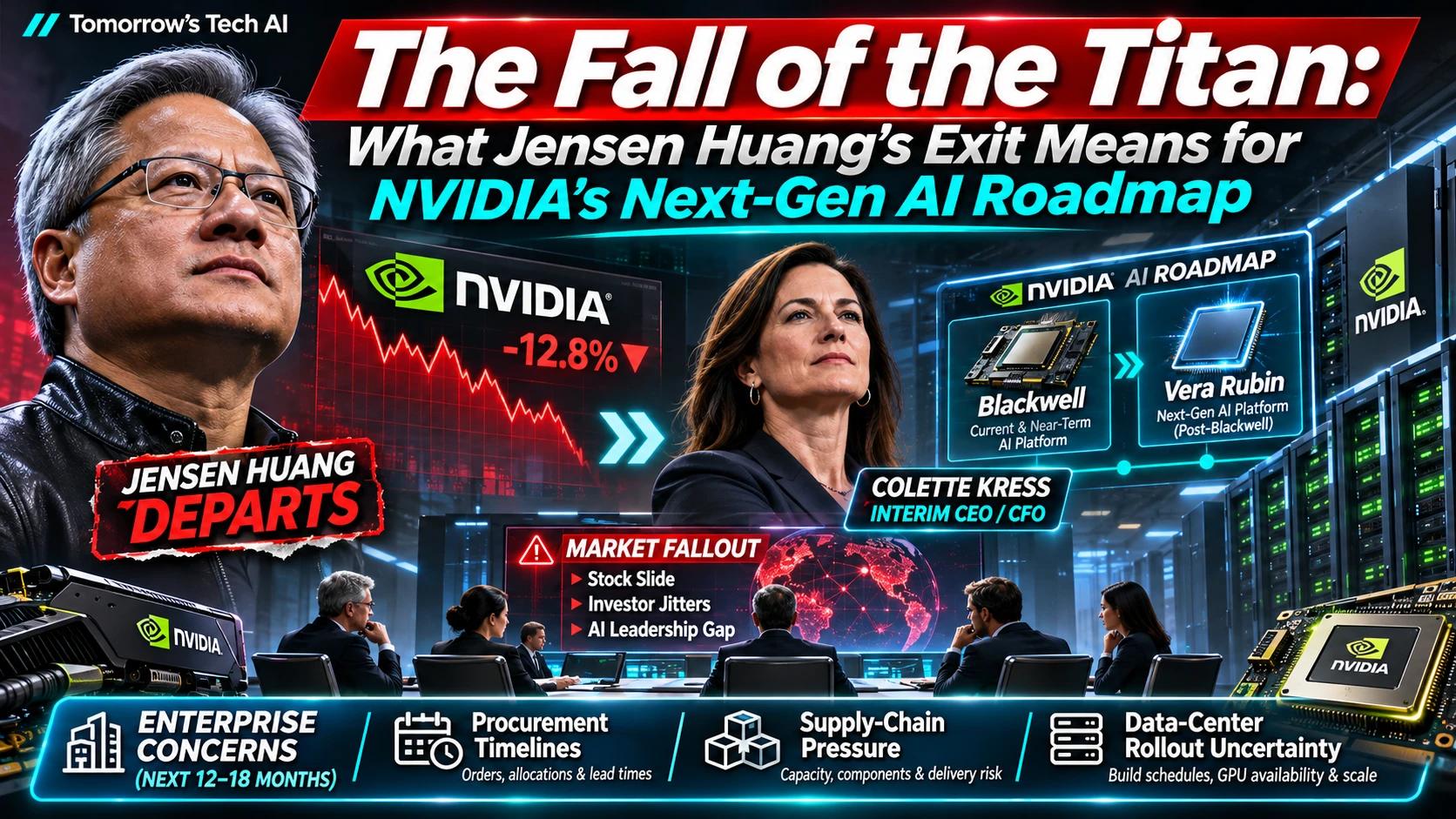
For 33 years, the face of Nvidia was one man in a black leather jacket walking a keynote stage. On Thursday, Nov. 12, that ended. Nvidia's board announced that Jensen Huang had resigned as president, CEO and board member, effective immediately. CFO Colette Kress is now interim CEO while keeping the CFO job, and Harvey C. Jones, former CEO and executive chairman of Synopsys, became the board's first-ever chair.[1]
The board's message to customers was direct. Jones said it expects "the company's operations, customer commitments and product roadmap to continue without interruption."[1] That is a statement of intent, not a guarantee, and Tuesday's earnings call will be the first real test of it.
If you run IT or buy hardware for a mid-sized business, you don't need an opinion on the scandal. You need to know which parts of your AI plans depend on Nvidia's leadership and which don't. This piece separates the two, and lays out what to put in writing before your next order.
We covered the board investigation on Nov. 9 in our earlier piece for AI hardware buyers. The short version: Huang's resignation followed reports that he had a relationship with a woman whom U.S. authorities reportedly suspect of spying for China.[7][9] Those are reports and allegations, not findings. Nvidia's announcement gave no reason for the resignation and did not quote Huang.[1] We'll leave his personal life there. The business questions are the ones that matter to buyers.
How the market reacted (dated, and not investment advice)
Nothing here is investment advice. We track the stock only because it signals how much uncertainty the market is pricing in.
- Thursday, Nov. 12: Nvidia fell as much as 16% during the session before closing down 4.3%.[8] Rivals moved the other way: AMD gained 5.9% and Broadcom rose 5.5%.[7] Reuters noted the stock was trading around 12 times expected earnings, its lowest valuation since 2012.[7]
- Monday, Nov. 16: Shares fell another 4.12%, their lowest close since July 1, 2025.[9]
- The longer run: The stock has fallen six straight weeks, the longest losing streak since 2012, a drop CNBC puts at about $1.7 trillion in market value.[10]
Analysts are split between "the machine keeps running" and "the deals slow down." JPMorgan said it expects the Nvidia team "to maintain its leadership in AI" while warning that "one execution misstep often leads to more."[8] Morgan Stanley cut its calendar 2027 and 2028 data center sales estimates by about 10%, and said it may be cutting to an overly conservative number.[10]
One thing we looked for and did not find: a public statement from a major cloud or enterprise customer about continuity. As of Monday evening, the reassurance is coming from Nvidia's board, not from the buyers. Watch for that to change.
What's already locked in: the roadmap through 2026
Chips that are designed, taped out and in manufacturing don't care who the CEO is. They depend on foundries, memory suppliers and packaging capacity. Here's what Nvidia itself has said is in that pipeline.
Blackwell and Blackwell Ultra are the revenue engine today. In its August results for the second quarter of fiscal 2027, Nvidia reported $96.2 billion in revenue.[3] Data center revenue was $89.0 billion, which the company attributed to "the ramp of our Blackwell Ultra infrastructure," and it said Blackwell "remains the vast majority of our revenue."[4]
Vera Rubin is ramping now. In the same release, Nvidia said Vera Rubin was "ramping into full production" with racks running at partners including CoreWeave, Google Cloud, Microsoft Azure, Oracle Cloud Infrastructure and Nebius.[3] Its inventory rose to $31.6 billion "as we prepare for the introduction of Vera Rubin in the third quarter."[4]
The supply is already bought. Nvidia's purchase commitments jumped from $119 billion to $279 billion in one quarter, mostly memory. That includes $92 billion for the rest of fiscal 2027, $87 billion in fiscal 2028 and $88 billion in fiscal 2029.[4] Commitments of that size run on contracts, not on one executive's relationships.
Packaged deployments are scheduled. On Oct. 21, Nvidia announced DSX POD, a containerized reference design for Vera Rubin AI factories built and validated by partners such as Dell, HPE, Lenovo, Schneider Electric and Vertiv, with deliveries expected worldwide in early 2027.[5] Nvidia claims the approach cuts deployment at a prepared site "from six months to as little as 14 days."[5] That's a vendor claim; treat it as one.
What's further out, and more exposed
Beyond 2026, the roadmap is a plan, not a product. According to coverage of Huang's GTC keynote in March, Rubin Ultra follows in 2027, and the Feynman generation, paired with a new CPU called Rosa, is slated for 2028.[6] Nvidia's August results release doesn't mention either name,[3] so we treat those dates as the last stated plan, reported secondhand.
Our take: engineering schedules for 2027 and 2028 parts were set long before last week, and a deep bench runs them. The bigger exposure is in the things Huang personally drove.
- Allocation. CNBC reports Huang was integral in deciding who got chips first.[10] When supply is tight, who makes that call, and on what basis, matters to every buyer in line.
- Financing and backstops. Nvidia has acted as supplier, investor and financier to the newer AI clouds. A financing program Huang announced in August with six major financial firms has yet to produce a completed deal.[10] Bloomberg Intelligence analyst Kunjan Sobhani told CNBC those kinds of deals "could slow down."[10]
- Export policy. JPMorgan said the risk of more restrictive guidelines on shipments into China has risen.[8] Tighter rules can mean more paperwork and end-use checks for everyone, not just buyers in Asia.
- Pricing posture. Nvidia's pricing and bundling decisions have been founder-led for decades. We have no reporting that anything has changed, and we're not predicting a change. It's simply a decision that now sits with different people.
The table: stable, watch, do
| Area | Likely stable | What to watch | What to do |
|---|---|---|---|
| Blackwell / Blackwell Ultra orders | In volume production; most of Nvidia's revenue[4] | Lead-time changes from your reseller or OEM | Get ship dates in writing on the purchase order |
| Vera Rubin (2026 ramp) | Ramping, racks at major clouds[3] | Any change to the ramp language on Tuesday's call | Don't re-plan around rumors; re-plan around Nvidia's own statements |
| Rubin Ultra / Feynman (2027–28) | Last stated plan[6] | Whether leadership reaffirms dates | Keep 2027+ capacity plans flexible; avoid prepaying |
| Allocation and priority | Contracts already signed | Who owns allocation decisions now | Confirm your allocation with your OEM, not with press coverage |
| Financing, leases, cloud credits | Signed agreements | Neocloud deals slowing[10] | Check your AI cloud provider's financial health and exit terms |
| Pricing and terms | Existing quotes | New bundling or software licensing | Lock quotes with an expiry date you control |
How to insulate your AI plans from executive turbulence
None of this is specific to Nvidia. Any time a critical supplier goes through a leadership shock, the playbook is the same. Anyone who has run field programs knows the rule: never let one subcontractor own the critical path without a fallback.
Put delivery in the contract, not in the conversation. Committed ship dates, partial-shipment rights, a remedy if dates slip (credit, cancellation without penalty, or substitution with an equivalent part), and price protection for the order. A friendly email from a rep is not a commitment.
Avoid prepaying for futures. Pay for hardware that exists. If a vendor wants deposits on 2027 platforms, ask what happens to your money if the schedule moves.
Keep more than one path. That can be a second hardware vendor, a cloud GPU contract you can scale up, or a workload that runs on whatever accelerators are cheapest that quarter. Most business AI work (document processing, search over your own files, drafting) doesn't need next year's flagship. As our piece on a used-V100 private AI server shows, older owned hardware can do real work for years.
Write your software to move. Containers, standard model formats and an inference layer you can point at a different backend. If swapping hardware means rewriting your applications, you don't have a second vendor, you have a second invoice.
Own the part you can own. Hardware sitting in your building keeps running no matter who runs the supplier. If you're weighing that against cloud, our break-even analysis shows how to run the numbers.
Keep humans on the approval line. Our standing rule is "propose, never act": systems draft and recommend, people approve the purchases and commitments that carry risk. A supplier shock is exactly when you don't want an automated reorder or auto-renewal firing on stale assumptions.
What to listen for on Tuesday's call
Nvidia reports third-quarter fiscal 2027 results on Tuesday, Nov. 17, at about 1:20 p.m. Pacific, with the call at 2 p.m. Pacific (5 p.m. Eastern). The call is webcast live in listen-only mode at investor.nvidia.com, and Kress's written CFO commentary posts right after the results.[2]
For context, Nvidia guided to $108.0 billion in revenue, plus or minus 2%, with no data center compute revenue from China assumed.[4] Analysts polled by LSEG expect $109.1 billion.[10] We won't predict the result. For a buyer, the number matters less than these signals:
- Roadmap language. Does Nvidia restate the Vera Rubin ramp and the next-generation schedule in its own words, or go vague?
- Supply commitments. Any change to the $279 billion purchase book is a direct signal about future supply.[4]
- Who answers questions. On past calls, Kress read prepared remarks and Huang handled analyst questions alone.[10] Who fields technical and roadmap questions now tells you who is steering product.
- Export and customer-screening changes. New know-your-customer steps will flow down to resellers and, eventually, to you.
- Succession timing. The board is considering internal and external candidates.[1] A long, open search means a longer period of interim decisions.
Checklist for this week
- List every open Nvidia-dependent order, quote and cloud GPU contract, with ship dates and owners.
- Ask your OEM or reseller to confirm allocation and lead times in writing.
- Check whether your quotes have price protection and an expiry you control.
- Identify one alternate path per critical workload: second vendor, cloud burst or older hardware.
- Pause any deposit on hardware that ships after mid-2027 until the roadmap is restated.
- Listen to Tuesday's call, or read the CFO commentary, and note the five signals above.
- Revisit this list in 30 days. Interim periods are when terms quietly change.
FAQ
Will Nvidia's Vera Rubin be delayed because Jensen Huang resigned?
Nothing official says so. Nvidia said in August that Vera Rubin was ramping into full production, and the board says it expects the roadmap to continue without interruption.[3][1] Chips already in manufacturing depend on supply chains, not on the CEO. Watch Tuesday's call for Nvidia's own wording.
Who is running Nvidia now?
Colette Kress, Nvidia's CFO since 2013, is interim CEO and remains CFO until a permanent successor is named. Harvey C. Jones is the board's first chair.[1]
Should we pause or cancel our Nvidia GPU order?
For hardware that's in production today, we see no reason to cancel based on the leadership change alone. Do make sure ship dates, remedies and pricing are written into the order. Be more cautious about prepaying for platforms that ship in 2027 or later.
Is Nvidia stock a buy after the drop?
We don't give investment advice. This article covers the stock only as a dated signal of market uncertainty.
Sources
- NVIDIA Announces CEO TransitionHuang resignation effective immediately; Kress interim CEO and CFO; Harvey C. Jones first-ever board chair; Jones quote on operations, customer commitments and roadmap; search considers internal and external candidates.
- NVIDIA Sets Conference Call for Third-Quarter Financial ResultsResults ~1:20 p.m. PT Nov 17, 2026; call 2 p.m. PT; listen-only webcast at investor.nvidia.com; CFO commentary posted after results.
- NVIDIA Announces Financial Results for Second Quarter Fiscal 2027Revenue $96.2B; Vera Rubin 'ramping into full production' with racks at CoreWeave, Google Cloud, Microsoft Azure, OCI, Nebius. Rubin Ultra and Feynman not mentioned.
- CFO Commentary on Second Quarter Fiscal 2027 ResultsData Center $89.0B driven by Blackwell Ultra ramp; Blackwell 'vast majority' of revenue; inventory $31.6B ahead of Vera Rubin introduction in Q3; commitments $279B ($92B rest of FY27, $87B FY28, $88B FY29); Q3 outlook $108.0B +/-2%, no China data center compute assumed.
- NVIDIA Introduces DSX POD AI Factories to Accelerate Europe's Infrastructure DeploymentContainerized Vera Rubin reference design; partner deliveries worldwide in early 2027; vendor claim of six months to as little as 14 days at a prepared site.
- Driving Down The AI System Roadmap With NvidiaTimothy Prickett Morgan on the GTC 2026 roadmap: Vera Rubin volume shipments 2H 2026, Rubin Ultra in 2027, Rosa-Feynman systems in 2028.
- Wall Street ends lower as Nvidia CEO resigns; US yields upNvidia closed down 4.3% Nov 12; AMD +5.9%, Broadcom +5.5%; ~12x expected earnings, lowest since 2012; reports the woman is suspected by US authorities of spying for Beijing.
- Nvidia stock falls after Huang resigns, weighing on broader marketSteve Kopack. Fell as much as 16% intraday, closed down 4.3%; JPMorgan quotes on China shipment restrictions and execution.
- Nvidia stock falls as investors price in fallout from Jensen Huang's resignationKai Nicol-Schwarz. Nov 16: down 4.12%, lowest close since July 1, 2025.
- Nvidia's Colette Kress confronts key questions in first earnings report since Jensen Huang's exitKif Leswing. LSEG consensus $109.1B; six straight weekly declines, ~$1.7T market cap lost; Morgan Stanley ~10% estimate cut; Bloomberg Intelligence (Kunjan Sobhani) on neocloud deals; Huang's role in allocation and financing; call format.
● Build with us
Review your AI hardware plans
We'll check your GPU orders, delivery terms and fallbacks against supplier risk before your next purchase. 30 minutes, no pitch, real conversation.
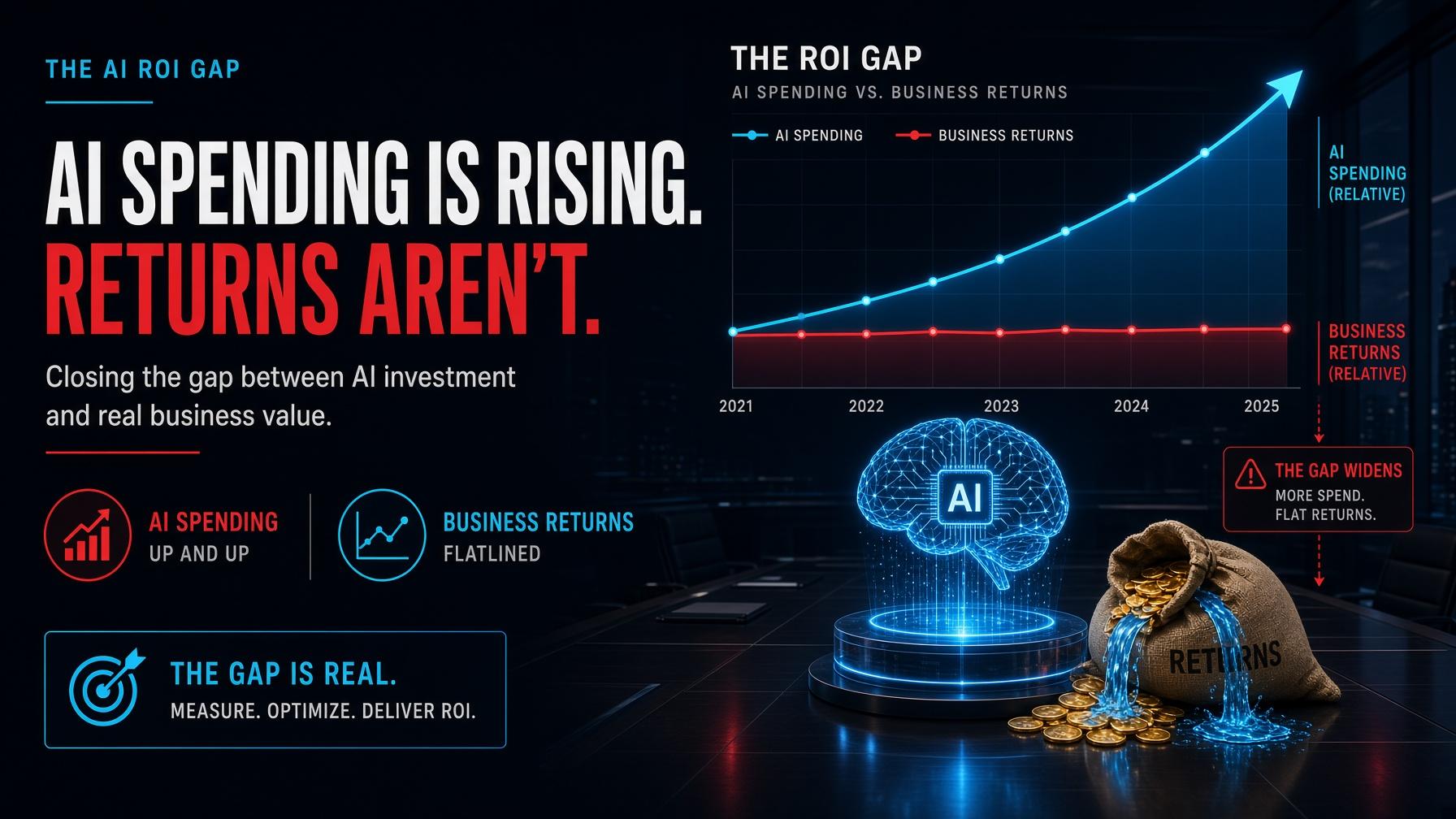
The AI ROI Gap: 60% Plan to Spend More on AI. Only 37% See Any Profit From It.
Apple Pay Just Went Down. That's the Fifth Big Outage in Six Days. Here's the Backup Plan Your Business Needs.