The AI ROI Gap: 60% Plan to Spend More on AI. Only 37% See Any Profit From It.
AI budgets keep rising while the share of companies reporting profit impact holds flat. What the research shows, and an operator's way to close the gap.
In this article
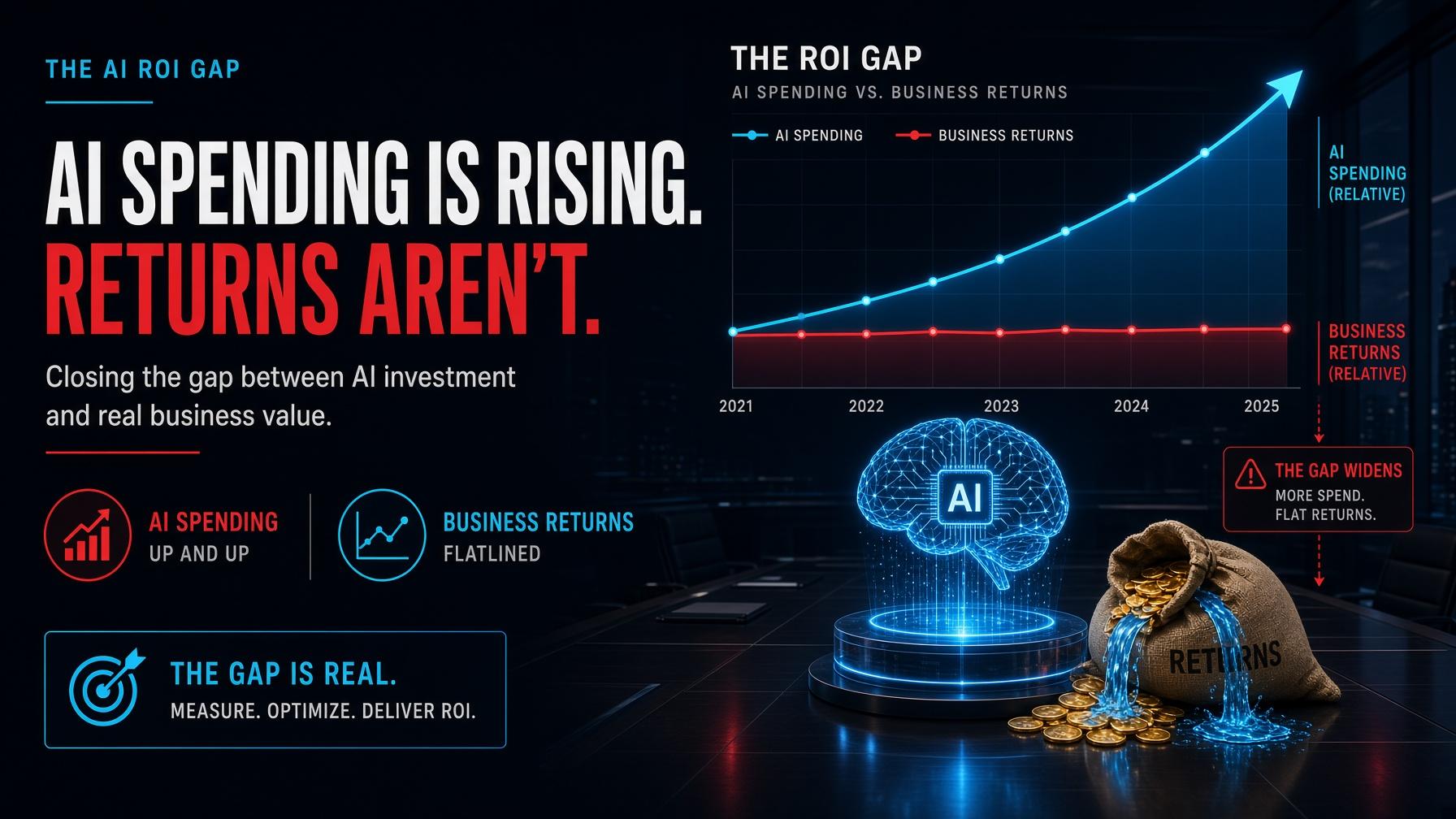
Most companies are not short on AI ambition. In McKinsey's 2026 State of AI survey, 60% of respondents said their organizations expect to increase AI investment over the next year.[1] In the same survey, only 37% said AI had contributed anything at all to EBIT, a share McKinsey describes as essentially unchanged from 2025.[1]
That is the AI ROI gap in one sentence. Spending keeps climbing. The share of companies that can point to profit impact does not. Individual employees feel it working (80% of McKinsey's respondents say AI improved their own productivity), but those gains are not adding up to a better income statement for most businesses.[1]
This piece looks at what the credible 2025 and 2026 research actually says, why the money is not converting into returns, and how an operator closes the gap: one painful workflow at a time, measured before and after, with a named owner. If you are a COO or CFO being asked to approve next year's AI budget, this is the conversation to have first.
What the research actually says
You may have seen a version of this headline: "60% of companies are spending more on AI while seeing flat returns." No single study says exactly that. Two real numbers sit underneath it, and they mean different things.
The first is McKinsey's: 60% of respondents expect their organizations to increase AI investment in the coming year, while the share reporting any EBIT impact has held flat at roughly 37%.[1] McKinsey surveyed 1,719 participants in 97 countries between May and June 2026, weighted by national GDP.[1]
The second is BCG's. In a September 2025 survey of 1,250 senior executives, BCG classed 60% of companies as "laggards" that report minimal revenue and cost gains from AI. Another 35% were scaling and starting to see value. Only 5% were "future-built" and generating substantial value.[2]
Other studies point the same direction, with different definitions:
| Study | Who was asked | Headline finding |
|---|---|---|
| McKinsey State of AI 2026 | 1,719 respondents, 97 countries | 37% report any EBIT impact from AI, flat year over year; 6% are "high performers"[1] |
| BCG, The Widening AI Value Gap (2025) | 1,250 senior executives | 60% report minimal revenue and cost gains; 5% generate substantial value[2] |
| MIT NANDA, The GenAI Divide (2025) | 300+ public initiatives, 52 organizations interviewed, 153 leaders surveyed | 95% of organizations getting zero return on generative AI[3] |
| S&P Global Market Intelligence (2025) | 1,006 IT and business professionals, North America and Europe | 42% abandoned most of their AI initiatives, up from 17% a year earlier[5] |
| U.S. Census Bureau BTOS (May 2026) | U.S. businesses | 19.8% of businesses using AI as of May 3, 2026[6] |
One more data point matters for mid-sized operators. The Census Bureau's survey found AI use rising among firms with at least 20 employees, but not changing significantly among firms with fewer than 20.[6] Use among firms with 250 or more employees was 37%.[6] Adoption is still early for most of the businesses this blog is written for, which is good news. You can learn from the expensive mistakes larger companies have already made.
Why the money isn't turning into returns
When I ran construction and telecom infrastructure programs, the projects that went sideways rarely failed because of the tools. They failed at the handoffs: unclear scope, no baseline, nobody accountable for the outcome. AI projects fail the same way. The research lines up behind five causes.
1. Pilots that never reach the workflow
A pilot proves the tool can do something. It does not prove the business does anything differently. S&P Global found that 46% of AI proofs of concept were scrapped before reaching production.[5] Fortune's account of the MIT report puts it more bluntly: about 5% of AI pilot programs achieve rapid revenue acceleration, and most stall with little measurable effect on profit and loss.[4]
A pilot that lives in a sandbox, used by three enthusiasts, will not move EBIT no matter how good the demo was.
2. Tools bolted on instead of processes redesigned
This is the clearest separator in McKinsey's data. Nearly three-quarters of AI high performers say they have fundamentally redesigned workflows because of AI. Only about one-quarter of everyone else has.[1]
BCG reached the same conclusion from a different angle. One of its report's co-authors said companies "urgently need to redesign how work gets done" to get value from AI agents.[2] Dropping a chatbot on top of a broken intake process gives you a faster broken intake process. We wrote about what those broken handoffs cost in the hidden cost of broken workflows.
3. Bad data foundations
AI reads whatever your systems hold. If job status lives in three spreadsheets and a superintendent's text thread, the model will be confidently wrong. Gartner has predicted that organizations will abandon 60% of AI projects that lack AI-ready data, and reported that 63% of organizations lack confidence in their data management practices for AI.[7] BCG lists a fit-for-purpose technology architecture and data foundation as one of five strategies leading companies follow.[2]
4. No baseline, so no proof
You cannot show a return on a number you never measured. McKinsey found high performers are twice as likely as others to say their organizations have defined processes to measure the impact of AI initiatives.[1] BCG's playbook calls for "rigorous tracking of results."[2]
Most of the companies I talk to can tell you what an AI tool costs per seat. Very few can tell you how many hours a week their team spent on the task before the tool arrived.
5. Nobody owns the outcome
AI projects often get owned by IT or by an enthusiastic individual, while the workflow they touch is owned by operations. When results slip, nobody has the authority to change the process. McKinsey found high performers are twice as likely as others to say senior leaders demonstrate commitment to AI initiatives.[1] That is not a slogan. It means someone with operational authority signs their name to the target.
There is a sixth, quieter problem: spending in the wrong place. Per Fortune's summary of the MIT research, more than half of generative AI budgets go to sales and marketing tools, while the biggest ROI showed up in back-office automation.[4] The unglamorous work of scheduling, invoicing, dispatch and reporting is where operational businesses have the most to gain.
The operator's method: one workflow, measured end to end
The fix is not a bigger AI strategy deck. It is the same discipline you would apply to any operational improvement. Pick one workflow, measure it, redesign it, measure it again, then scale what worked. We covered the most common way companies skip these steps in the #1 AI mistake businesses make.
Step 1: Pick one painful workflow
Good candidates share three traits. They are high-volume, they are measurable today, and the people doing them complain about them. Examples from operational businesses:
- Turning daily field reports into a schedule update
- Matching vendor invoices to purchase orders and receiving tickets
- Building the weekly status report for leadership
- Qualifying and routing inbound service requests
- Checking crew or subcontractor compliance before assignment
Avoid starting with anything that has no current measurement, no single owner, or a regulatory exposure you have not mapped.
Step 2: Baseline it before you touch it
Spend two to four weeks measuring the workflow as it runs today. Cycle time, hours per week, error or rework rate, and cost per unit are usually enough. Write the numbers down and get the workflow owner to agree they are fair. This is the step most AI projects skip, and it is the reason most of them cannot prove anything later.
Step 3: Redesign the process, then add AI
Map the current steps. Remove the ones that only exist because of old system limits. Decide where a person must approve and where software can act. Only then decide where AI fits: drafting, classifying, extracting, summarizing or flagging exceptions.
Keep a human approval step on anything that commits money, changes a schedule or goes to a customer. You can loosen that once the data shows the system is reliable.
Step 4: Measure the same way, on the same cadence
Use the exact metrics from Step 2. Track adoption too. A tool that half the team ignores will show half the return, and you need to know whether the problem is the tool or the rollout.
Step 5: Scale only what clears the bar
Set the threshold before you start, for example "at least a 30% cut in cycle time with no increase in errors." If the workflow clears it, roll it out to the next team or site. If it does not, you have spent a few weeks and learned something specific, which is a far better outcome than a year-long platform rollout with no numbers.
A simple ROI measurement template
Here is the kind of one-page scorecard we recommend for each workflow. The numbers below are illustrative only, made up to show how the math works. They are not results from any client or study.
| Metric | Baseline (before) | After 60 days | Change | How it's measured |
|---|---|---|---|---|
| Hours per week on weekly ops report | 12 hrs | 4 hrs | -8 hrs | Time log from report owner |
| Cycle time, field report to schedule update | 2 days | 4 hours | -1.5 days | Timestamps in scheduling system |
| Reports needing rework | 20% | 8% | -12 pts | Count of revisions per week |
| Loaded labor cost of the task (at $55/hr) | $660/wk | $220/wk | -$440/wk | Hours x loaded rate |
| AI and software cost | $0 | $150/wk | +$150/wk | Invoices, prorated |
| Net weekly impact | $290/wk | Labor saved minus tool cost |
A few rules make this honest:
- Count the full cost. Licenses, usage fees, integration work and the hours your team spends reviewing AI output. McKinsey found about one in five organizations say AI operating costs, including token costs, have constrained their use.[1]
- Separate time saved from money saved. Eight freed-up hours only become profit if they go to billable work, more volume or avoided hiring. Write down where the hours went.
- Keep the quality metric. Speed with more errors is not a gain.
- Review it monthly with the workflow owner. The scorecard is a management tool, not a report card for the vendor.
This is also where a command center earns its keep. When every pilot has its baseline and current numbers on one screen, leadership can see which workflows are paying back and which are not. We explain that idea in why companies need a command center.
Close the gap in 90 days
A practical plan for a mid-sized operations business:
- Days 1 to 15: Choose and baseline. Pick one workflow using the criteria above. Name an owner from operations, not IT. Start measuring.
- Days 16 to 30: Fix the data and the process. Clean up the inputs the workflow depends on. Map the steps, remove waste and decide where human approval stays.
- Days 31 to 60: Build and run. Add AI where the redesigned process needs it. Run it on real work with the people who do the job. Track the same metrics weekly.
- Days 61 to 75: Compare against baseline. Fill in the scorecard. Count every cost. Decide whether it cleared the threshold you set on day one.
- Days 76 to 90: Scale or stop. Roll a winner to the next team or site, and pick workflow number two. Shut down a loser and write down why.
Ninety days and one workflow will not show up in a McKinsey survey. It will give you something most companies spending on AI do not have: a measured, defensible number you produced yourself.
What this means for owners and CFOs
The research does not say AI fails to pay. It says AI pays for a small group of companies that treat it as an operational change, and not for the majority that treat it as a software purchase. BCG found its future-built companies achieve 1.7 times the revenue growth and 1.6 times the EBIT margin of laggards.[2] BCG also put construction near the low end of AI maturity across sectors.[2] For contractors and field-service companies, that means the gap is wide, and so is the room to get ahead of competitors.
Before approving more AI spend, ask three questions of every line item. Which workflow does this change? What is that workflow's baseline today? Who owns the result? If nobody can answer, the money is not ready to be spent.
FAQ
Is it true that 95% of AI projects fail?
Not exactly. The MIT NANDA report found 95% of organizations were getting zero return on generative AI, defining success as a marked and sustained productivity or P&L impact.[3] It studied generative AI specifically, from a limited sample, during the first half of 2025. Other surveys using broader definitions find more companies seeing some return, but still a minority.[1]
How long should an AI pilot take to show ROI?
For a single, well-scoped workflow, 60 to 90 days is a reasonable window to see whether the numbers move against a baseline. If you cannot measure a change in that window, the problem is usually scope, data or adoption, not time.
Should we build our own AI tools or buy them?
MIT's research found purchased tools and external partnerships succeeded about twice as often as internal builds.[3] For most mid-sized companies, the better move is to buy or partner for the AI capability and invest your own effort in process redesign and clean data.
What is the single best predictor of AI returns?
Across the studies cited here, the strongest common thread is workflow redesign backed by measurement. McKinsey's high performers redesign workflows and define how they will measure impact far more often than everyone else.[1]
Where sources disagree
How many companies are getting a return on AI
- [3] 95% of organizations are getting zero return on generative AI (success = marked and sustained productivity and/or P&L impact).
- [1] 37% of respondents attribute at least some EBIT impact to AI of any kind, roughly unchanged from 2025.
- [2] 60% of companies are laggards reporting minimal revenue and cost gains; 40% are scaling or generating substantial value.
Our read: The studies measure different things: generative AI only vs all AI, sustained P&L impact vs any self-reported EBIT contribution vs a capability-maturity score. We report each figure with its definition. All three agree that a majority of companies cannot yet show meaningful enterprise-level returns.
MIT NANDA study methodology
- [3] The report PDF describes 300+ public initiatives reviewed, structured interviews with representatives of 52 organizations, and 153 senior-leader survey responses (January to June 2025).
- [4] Fortune describes 150 leader interviews, a survey of 350 employees, and analysis of 300 public AI deployments.
Our read: Unresolved. We cite the methodology as stated in the report PDF.
Sources
- The state of AI in 2026: On the road to ROIOnline survey, May 4 to June 8, 2026; 1,719 participants in 97 countries; weighted by each nation's share of global GDP. Self-reported attribution of EBIT impact.
- AI Leaders Outpace Laggards with Double the Revenue Growth and 40% More Cost Savings (The Widening AI Value Gap: Build for the Future 2025)BCG press release summarizing its report. Global survey of 1,250 senior executives and AI decision makers; maturity scored across 41 capabilities.
- The GenAI Divide: State of AI in Business 2025Report PDF as hosted by mlq.ai; MIT distributes it via a request form. Methodology as stated in the PDF: review of 300+ public AI initiatives, interviews with 52 organizations, 153 senior-leader survey responses, January to June 2025. Covers generative AI only.
- MIT report: 95% of generative AI pilots at companies are failingReporting on the MIT NANDA study, including budget allocation and pilot outcomes.
- AI experiences rapid adoption, but with mixed outcomes: Highlights from VotE: AI & Machine LearningSurvey of 1,006 midlevel and senior IT and line-of-business professionals in North America and Europe.
- Large Firms With at Least 20 Employees Biggest AI UsersBusiness Trends and Outlook Survey. AI question was revised in November 2025 (from use 'in producing goods or services' to use 'in any business function'), so earlier and later rates are not directly comparable.
- Gartner reveals 60% of AI projects with data issues will failGartner's own press release ('Lack of AI-Ready Data Puts AI Projects at Risk', Feb 26, 2025) blocked automated access on the access date, so this summary is cited. The 60% figure is a Gartner prediction, not a measured outcome; the 63% figure comes from a Gartner survey conducted in July 2024.
● Build with us
Measure one workflow with us
We baseline one painful workflow, rebuild it, and put the before-and-after numbers on one screen. 30 minutes, no pitch, real conversation.