Apple Pay Just Went Down. That's the Fifth Big Outage in Six Days. Here's the Backup Plan Your Business Needs.
Apple Pay, iCloud and the App Store failed today after what Apple calls an internal update. It follows Outlook, the FAA ground stop and Chase. What happened, and the fallback plan every small business should have.
In this article
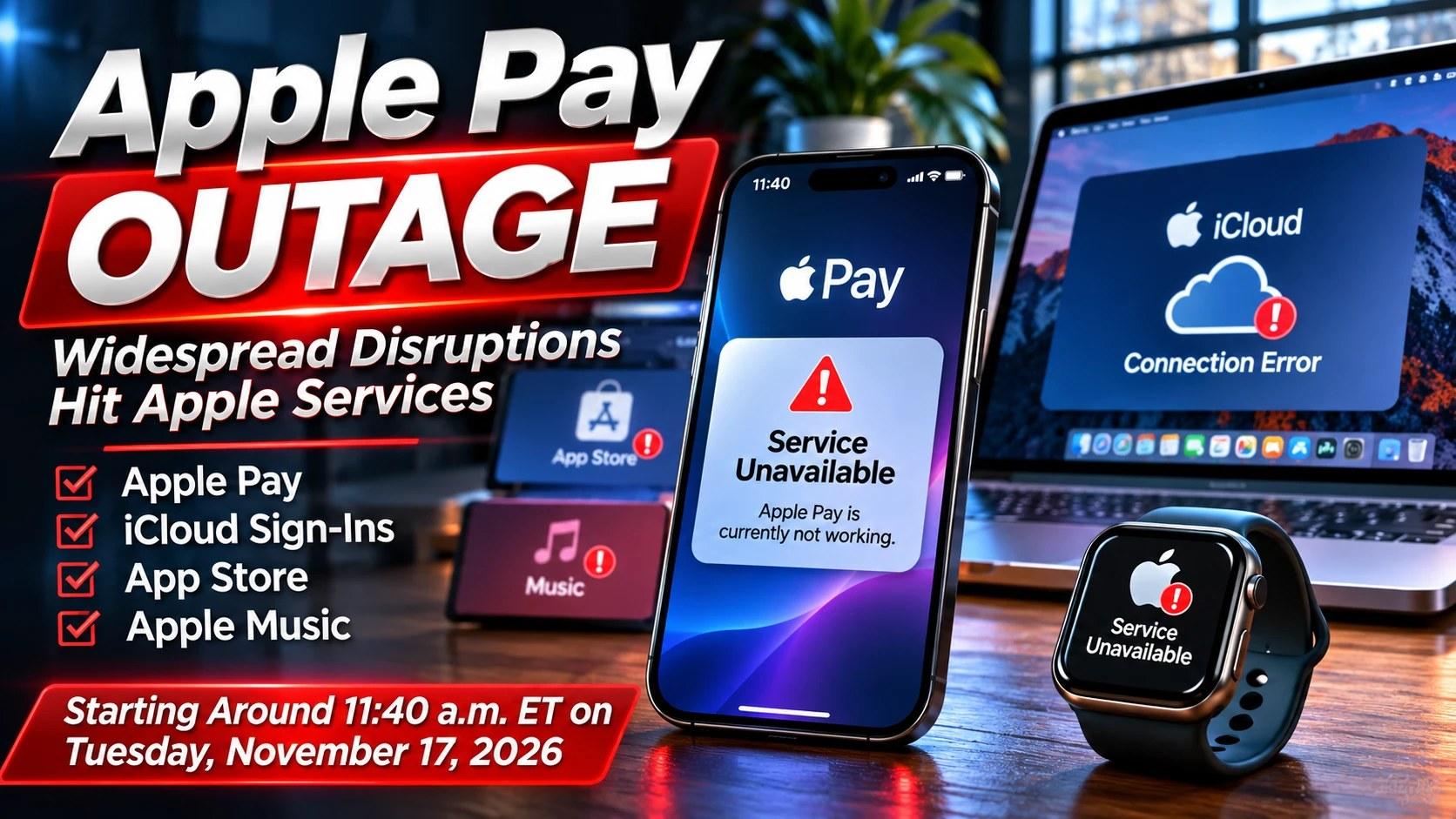
Around 11:30 this morning Eastern time, people started reporting that Apple services weren't connecting. Within an hour the reports on Downdetector were in the thousands: Apple Pay, iCloud sign-in, the App Store, Apple Music, even device activation.[1] Apple later said "an internal update caused some outages this morning," that many systems were back up, and that it was working to bring the rest online.[2]
If this feels familiar, it should. This is the fifth major U.S. outage in six days.
What broke this week
| When | What went down | What they say caused it |
|---|---|---|
| Thu, Nov 12 | Microsoft Outlook and other Microsoft 365 services, for days | A networking bug dating back to July, per Microsoft[3] |
| Fri, Nov 13 | FAA nationwide ground stop, about four hours, with delays rippling for days | A newly installed router flooding the network with connection signals[3][4] |
| Mon, Nov 16 | Chase online banking and account access; United's weight-and-balance system | A software bug, not a cyberattack, per officials[4] |
| Tue, Nov 17 | Apple Pay, iCloud, App Store, Apple Music | An internal update, per Apple[2] |
Gmail, Marriott's app and Schwab logins also had problems along the way.[2][3]
Is it a cyberattack?
So far, no evidence says so. Microsoft ruled out a cyberattack, the FAA traced its ground stop to a router, Chase blamed a software bug, and the Homeland Security secretary said there is "no cyber threat that's taking place."[3] Apple's own explanation is an update it pushed itself.[2]
That's actually the more uncomfortable answer. Nobody broke in. These are the biggest, best-staffed technology operations in the country, and each one went down because of a change it made to its own systems. An MIT cybersecurity professor called it a "perfect storm" of how dependent everything has become on everything else.[4]
Why this matters to a business that doesn't run on Apple
Most of the businesses I work with (contractors, field crews, clinics, service shops) didn't lose anything critical today. That's not the point. The point is that in one week, email, air travel, banking and phone payments each went dark for hours, and none of them asked permission first.
I spent years running construction and telecom infrastructure programs. On a jobsite you never have one way to get power, one way to reach the crew, or one supplier for something that stops the job. Most small businesses run their office the opposite way: one email provider, one card processor, one bank login, and nobody who knows the plan when one of them stops.
The backup plan: what to set up this week
- Take payment two ways. If customers pay by tapping a phone, make sure your reader also takes a physical chip card, and keep a way to collect later (an invoice link, a paper ticket with a card-on-file form, or a check). Find out whether your point-of-sale system has an offline mode and what its limits are before you need it.
- Keep a contact list that doesn't live in your email. When Outlook went down, a lot of people couldn't find a customer's phone number because it was buried in a thread. Export your key customer, crew and vendor contacts somewhere you can reach from a phone without that login.
- Have a second way to reach your team. A group text, a backup chat app, or a call tree. Decide which one now, not mid-outage.
- Know your bank's backup. Keep enough cash access (a second account or a card from a different bank) to cover a day or two of fuel, materials and petty cash if one bank's app is down.
- Bookmark the status pages. Apple, Microsoft 365, Google Workspace, your bank and your payment processor all publish one. Checking takes ten seconds and tells you whether the problem is yours or theirs.
- Write down who decides. If payments or email are down at 9 a.m. on a Monday, who calls customers, who reschedules, and who tells the crew? One name, written down.
None of this is expensive. It's the same thing a good superintendent does before a pour: figure out what happens when the thing you're counting on doesn't show up.
FAQ
Is Apple Pay working now?
Apple said many systems were back by mid-afternoon Eastern and it was still restoring the rest.[2] Check Apple's System Status page for the current state of each service.
Were my cards or payment details exposed?
Nothing reported so far points to a breach. Apple attributes the outage to an internal update, not an attack.[2]
Are these outages connected?
Each company and agency has given a different, internal cause, and officials say none were cyberattacks.[3] They look like separate failures that happened to land in the same week.
Key specifications
| Item | Value | Status | Source |
|---|---|---|---|
| Apple outage start | Around 11:30 a.m. ET Nov 17; reports in the thousands by 12:29 p.m. ET | Verified | [1] |
| Apple's stated cause | "An internal update caused some outages this morning" | Verified | [2][1] |
| Linked to a cyberattack? | No evidence so far; Microsoft, the FAA, Chase and DHS all point to internal causes | Verified | [3][4] |
Sources
- iCloud and other Apple services are down in an apparent outageTimeline from Downdetector reports and Apple's status page; updated 2:36 p.m. ET.
- Apple, Gmail, Marriott down in latest wave of widespread outagesApple spokesperson statement and the status page as of 2 p.m. ET.
- Tech outages live updates: Microsoft, banks and FAALive coverage: Microsoft's stated cause, the FAA router explanation, Chase and officials' statements on cyberattacks.
- Outages disrupt Outlook, banking and air travelSequence of the week's outages, the FAA ground stop's length, and Chase's stated cause.
● Build with us
Get an operations audit
We'll map which systems your business can't run without, what happens when each one goes down, and the simplest fallback for each. 30 minutes, no pitch, real conversation.