A Lawyer Built His Own Private AI Server. Here's Why Every Business Should Pay Attention.
A South Carolina trial lawyer turned eight used data-center GPUs into an AI server that reads his case files without sending them anywhere. The build is rough around the edges. The idea behind it applies to any business with information it can't afford to share.
In this article
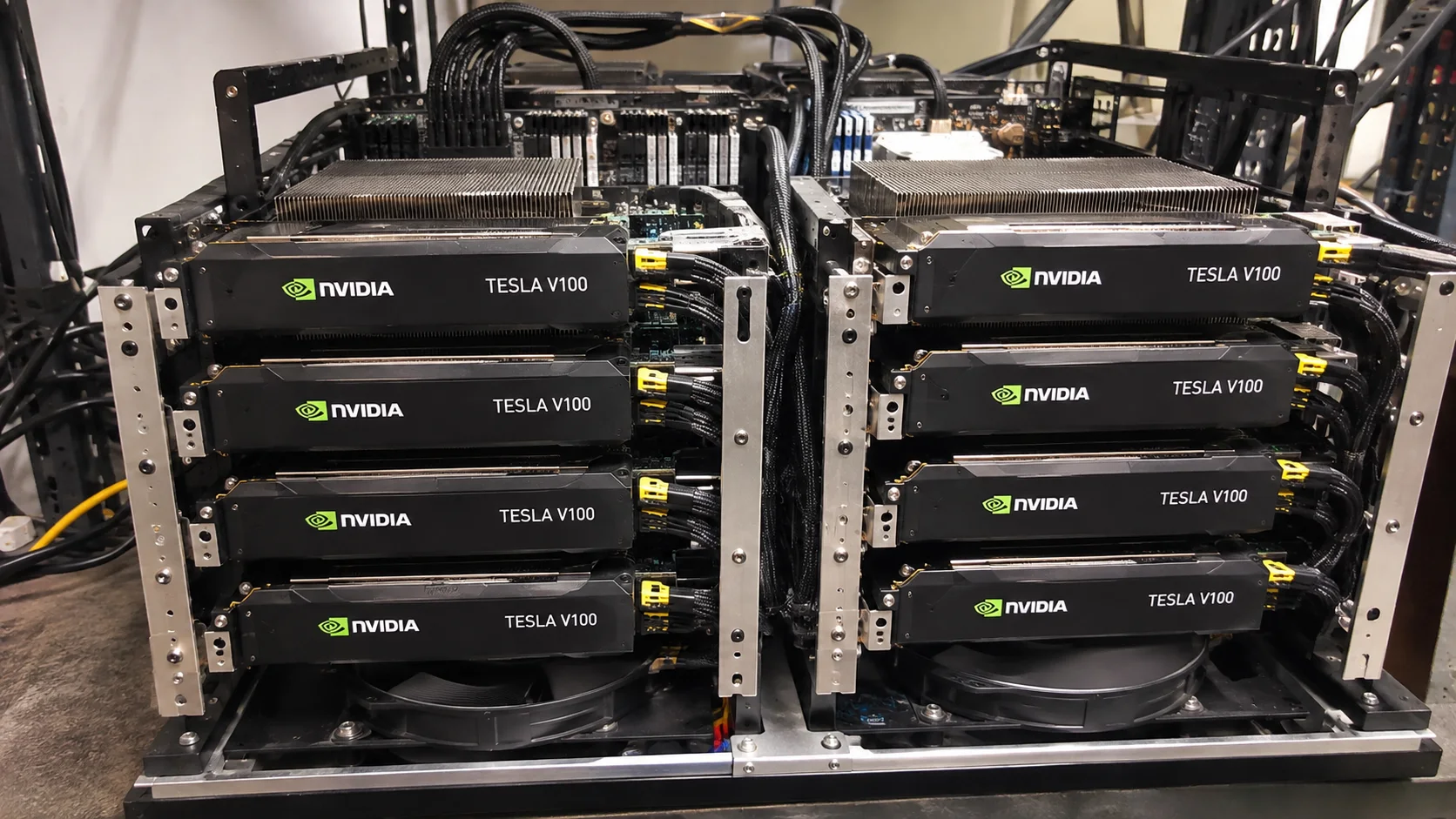
Most conversations about AI in business start with a subscription: pick a vendor, sign up, paste in your documents. Nick Mermiges took a different route. The South Carolina trial lawyer, who has practiced for more than eleven years, built an AI server out of used data-center parts so his case files never have to leave his office.[5][3]
He documented the build in public, including the parts that broke.[1] It's worth a close look even if you'll never own a GPU. The questions he had to answer are the same ones any business faces once its data is too sensitive to hand to someone else.
What he built
The heart of the machine is eight NVIDIA Tesla V100 GPUs. They are 2018 data-center cards, each with 32 GB of fast memory, mounted four to a board. The four cards on each board share a high-speed NVLink connection, which gives each board 128 GB of memory that works as one pool. The two boards talk to each other over ordinary PCIe, which is much slower.[1]
That design choice is the whole trick. Used boards like these were, in his words, "the cheapest big pool of fast VRAM I know of." He paid about $1,600 for four cards with heatsinks and about $750 for the board and a switch card, roughly $2,400 for each 128 GB block.[1] Those were his prices at the time. By early November 2026, Tom's Hardware found the same used cards listed at about $900 each, more than double what he paid.[3]
The rest is workstation hardware: a 12-core Threadripper PRO, 256 GB of server memory, and two power supplies totaling 2,800 W, plugged into two separate ordinary office circuits.[1]
How it performs
The server runs DeepSeek-V4.1-Flash, a large open AI model, compressed to mostly 2 bits so its 248.8 GB of weights fit the hardware. To keep the slow link between boards from becoming a bottleneck, the model is split in half: the first 20 layers run on one board, the last 20 on the other, so only one hand-off per step crosses PCIe.[1][3]
Here are his measurements from November 5, 2026:[2]
| Document size | Wait for first word | Code (tokens/s) | Legal writing (tokens/s) |
|---|---|---|---|
| 1K tokens | 1.2 s | 215 | 118 |
| 32K tokens | 17.2 s | 200 | 117 |
| 128K tokens | 59.2 s | 183 | 111 |
| 256K tokens | 118.7 s | 160 | 103 |
Code comes out faster than legal prose because a small built-in model guesses five tokens ahead, and code is easy to guess.[1] For a lawyer, the column that matters most is the second one. The server reads documents at about 2,200 tokens per second, so a 128K-token case bundle takes about a minute before the first word of the answer appears.[1]
What it took to get there
None of this worked on the first try. The machine reset itself twice with a fatal PCIe error, both times with the cards running at higher power and uncapped clock speeds. One GPU board had a burn mark on its power connector and was removed. System memory threw uncorrected errors until he slowed it from DDR4-3200 to DDR4-2666.[1]
The fix was patience and restraint. Each card now runs capped at 150 W with a lower clock speed, and he checks the memory error counters before and after every run. A higher 200 W cap made no measurable difference to speed.[1] Three days before his latest update, the same model on four cards managed 36–38 tokens per second; custom software work on the full eight-card setup produced the numbers above.[1]
What it does all day
The server does first-pass work on his own case files. It reads a folder of records, pulls out the facts, dates and numbers, writes summaries, and drafts routine documents. He drives it in plain English from a Windows PC, and it's connected to his own document databases.[1]
The rule that makes it usable is simple: nothing leaves the office without a real review by the lawyer.[1] The machine prepares. The lawyer decides.
By his estimate, 50–60% of his existing AI workflows can now run on this box instead of on cloud models.[1] He has said the goal is a fully offline setup, which he believes will have real value for regulated professions.[4]
The honest limits
It would be easy to read this as "anyone can replace cloud AI for a few thousand dollars." That's not what the build shows.
- One user at a time. The server handles a single request at a time today. Running two or three at once works on his test machine but isn't in production yet.[1][3]
- Long documents mean waiting. Fast generation doesn't remove the minute-long read on a large file.[1]
- Aggressive compression. Squeezing the model to about 2 bits is what makes it fit. He reports solid scores on legal and general benchmarks and is working on a higher-precision version that he hopes will run at about 80 tokens per second.[2][4]
- Old hardware, short runway. NVIDIA's R580 driver is the last branch that supports these Volta-generation GPUs, and CUDA 12 is their last toolkit family.[6] Anyone copying this build is buying into a frozen software stack.
- It's a serious engineering project. PCIe switches, cable runs, power limits and custom kernels. He calls it, in part, a hobby.[4]
Why every business should pay attention
The lawyer's motivation is professional duty. In July 2024 the American Bar Association issued Formal Opinion 512, its first formal guidance on generative AI. It reminds lawyers that the duty to keep client information confidential applies to these tools, and that client consent is needed before entering client information into AI tools that learn from what they're given.[7][8]
Most businesses don't answer to a bar association. Plenty answer to something similar: patient records, financial data, employee files, bid pricing, customer contracts, proprietary designs. The question this lawyer answered with hardware is one every one of those businesses has to answer somehow: which information is allowed to leave the building, and who decides?
Three lessons carry over directly:
- Private AI is now within reach of a small firm. One professional, working largely alone, built a system that handles real daily work on hardware bought used at a few thousand dollars per GPU board.
- The hardware is the easy part to buy and the hard part to run. The real work in this build was power, stability, memory errors, model splitting and software. That's an operations problem, not a shopping problem.
- Hybrid is the realistic starting point. Even this build sends part of the workload to cloud models today. Deciding which work runs where, and enforcing it, matters more than going all-in on either side.
What it would take for your business
If your company handles information it can't share, the path doesn't start with GPUs. It starts with a few plain questions:
- What data has to stay in-house, and which workflows touch it?
- Which tasks are worth automating first? Extraction, summaries and first drafts are where this lawyer started.
- How many people need it at once? Concurrency changes the hardware more than anything else.
- Who keeps it running? Drivers, updates, monitoring and security don't stop after setup.
- Where does a person review the output before it reaches a client or a decision?
Tomorrow's Tech AI designs and builds private AI systems for businesses that need this kind of control, from a single on-site workstation to a hybrid setup that keeps sensitive work local and sends the rest to approved cloud models. If you're weighing it, book a private AI consultation and we'll map what should stay in your building and what it would take.
Key specifications
| Item | Value | Status | Source |
|---|---|---|---|
| GPUs | 8× NVIDIA Tesla V100-SXM2, 32 GB HBM2 each (2018 data-center cards) | Verified | [1][3] |
| GPU layout | Two 4-GPU SXM2 boards; NVLink inside each board (128 GB per board), PCIe between boards | Verified | [1][3] |
| Cost per 128 GB board | About $2,400 (four cards ~$1,600, board and switch card ~$750)The builder's purchase prices. Tom's Hardware found used cards listed at about $900 each by November 2026. | Verified | [1][3] |
| Host | Threadripper PRO 3945WX (12 cores), 8× 32 GB DDR4 RDIMM | Verified | [1][3] |
| Power | Two PSUs, 2,800 W total, on two ordinary office circuits; each GPU capped at 150 W | Verified | [1][3] |
| Model | DeepSeek-V4.1-Flash, mostly 2-bit, 248.8 GB of weights; 524K-token context | Verified | [1][3] |
| Memory placement | All model experts in GPU memory; about 110 GB of Engram tables in system RAM | Verified | [1][2][3] |
| Driver | NVIDIA R580, the last branch that supports Volta GPUs | Verified | [1][6] |
| Users at once | One request at a time (two to three in testing) | Verified | [1][3] |
Where sources disagree
Is the setup fully offline today?
- [3] Headline describes the server as keeping legal files offline.
- [1] Documents processed on this server never leave the office, but by the builder's estimate it handles 50–60% of his AI work; the rest still runs on frontier models.
- [4] The builder says he is working toward a fully offline local setup.
Our read: Both are true at different scopes. Case files sent to this server stay in the building; the practice as a whole is not yet fully self-contained, by the builder's own account.
Sources
- Lawyer's V100 homelab, update: two 4-card SXM2 NVLink boards, four PEX switches, SlimSAS everywhere, one burnt power connector, and a 250 GB model running entirely in VRAM at 200+ tok/sThe builder's own write-up. Read as embedded in the Tom's Hardware article; the post's title predates the builder's correction about system RAM.
- Volta-sPLIt: DeepSeek-V4.1-Flash on 8x V100-SXM2 (PP2 x TP4), build notes and benchmarksThe builder's published configuration and full benchmark tables.
- Lawyer builds private AI server with eight used Nvidia V100 GPUs
- Comments by the builder on the Tom's Hardware articleThe builder identifies himself and describes his plans for a fully offline setup.
- Proprietary Legal Intelligence: about the founder
- CUDA Toolkit, Driver, and Architecture Matrix
- ABA issues first ethics guidance on a lawyer's use of AI toolsAnnounces ABA Formal Opinion 512, issued July 29, 2024.
- Generative Artificial Intelligence Tools: ABA Formal Opinion 512 Provides Needed Guidance
● Build with us
Private AI consultation
Keep sensitive data in the building with an on-site AI system. 30 minutes, no pitch, real conversation.