After Nvidia's CEO Exit: Find the Single Points of Failure in Your AI Stack
Nvidia's sudden CEO change and new chip export rules expose a risk most AI programs share: one person, one vendor, one model. How to map and reduce it.
In this article
Nvidia's board announced on Nov. 12 that Jensen Huang had resigned as president, CEO and director, effective immediately, with CFO Colette Kress stepping in as interim CEO while the board searches for a permanent one.[1] The board said it expects "operations, customer commitments and product roadmap to continue without interruption."[1] The Associated Press reported that Nvidia had no succession plan for Huang's departure, after more than 30 years with one person at the top.[2]
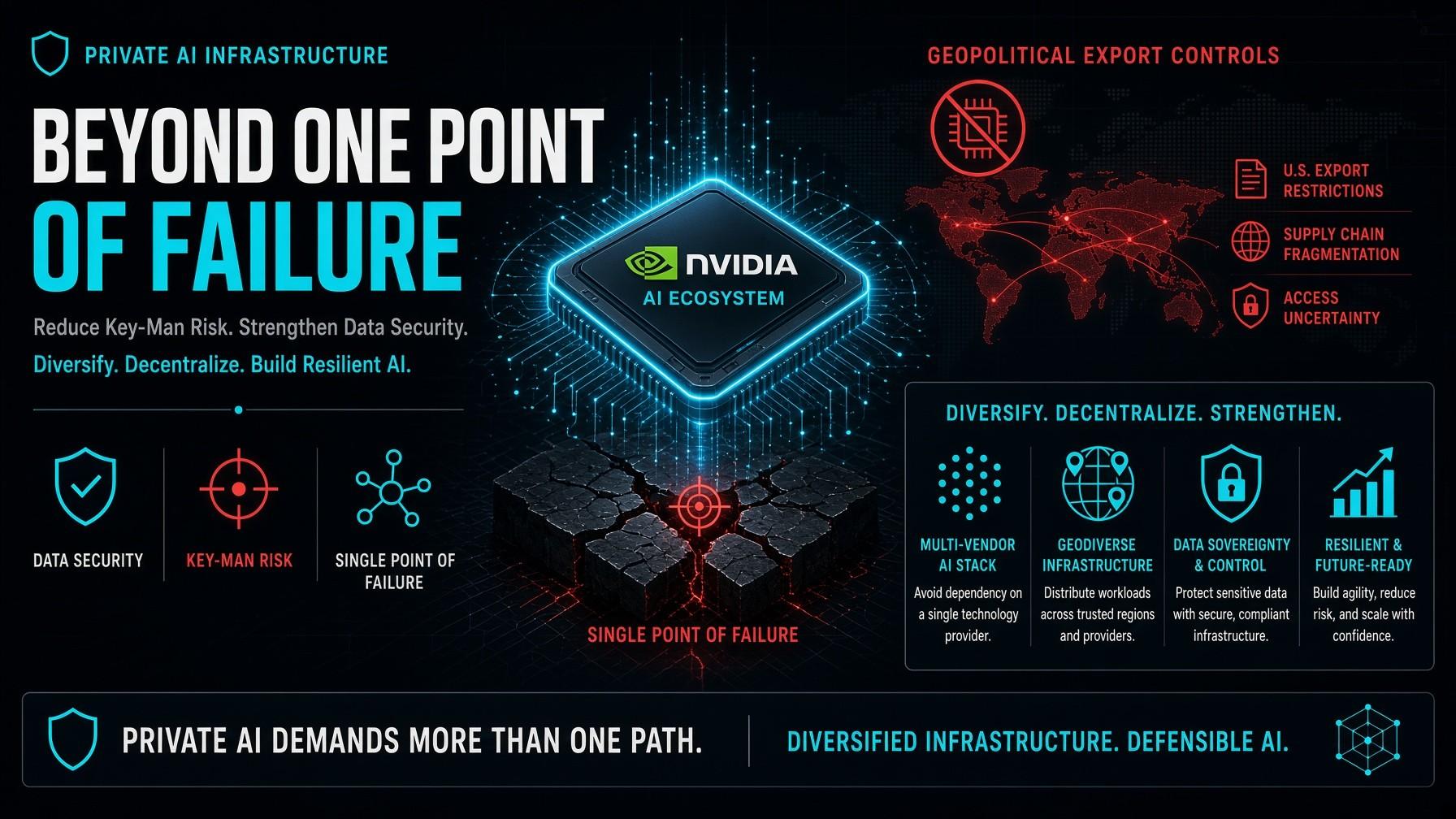
Most coverage is about one man and one alleged spy. For owners and operators, the useful story is structural. A company worth trillions learned in a week how much ran through one person, while Washington spent 2026 tightening who can touch advanced AI chips, including through rented cloud capacity. Both point at one question for any business building on AI: where are your single points of failure, and what happens to your data and operations if one breaks?
Here is what is confirmed as of Monday evening, Nov. 16, where export controls stand, and a practical way to map your own concentration risk. Nvidia reports results Tuesday. We make no predictions, and nothing here is investment advice.
What's confirmed, and what is still an allegation
We covered the start of this on Nov. 9 in what Nvidia's CEO investigation means for AI hardware buyers. Here is what changed since, with dates.
Confirmed:
- Nov. 12: Huang resigned. Kress is interim CEO and remains CFO. Harvey C. Jones, former CEO and executive chairman of Synopsys, became the board's first-ever chair.[1]
- Investigations and lawsuits: President Trump has said the FBI is looking into the matter, though Reuters notes his remarks did not say who the target was or what the scope is.[4] A proposed securities class action was filed in San Jose federal court on Nov. 9, and a shareholder derivative suit against the board followed on Nov. 11.[4]
- Congress: House Foreign Affairs Chairman Brian Mast said Huang would be subpoenaed if necessary.[2] On Nov. 12, Sen. Ron Wyden and Rep. Richard Neal opened an inquiry into the administration's approval of Nvidia chip exports to Chinese companies and asked Commerce to preserve related records.[5]
- Nov. 16: President Trump said he "would certainly not mind" Huang returning. A person familiar with the board's thinking told the AP the board is not currently considering it.[3]
Alleged, not proven:
- The New York Times reported that U.S. officials concluded Alice Huang, an unrelated former executive at Singapore-based Nvidia customer Megaspeed who had a relationship with Jensen Huang, was a Chinese intelligence asset. Reuters says it could not independently verify that allegation.[4]
- China's foreign ministry has called the allegation "groundless."[4] On Nov. 16, President Trump said, "Nobody's proven that she's a spy."[3]
- Huang has not been accused of criminal wrongdoing.[4] Nvidia has said it has "no reason to believe" national security or company secrets were compromised.[2]
Investigations are open, nothing has been decided, and the facts may move.
Where AI chip export controls stand in November 2026
Four developments this year matter for anyone buying or renting GPU capacity.
1. H200 sales to China moved to case-by-case review. On Jan. 13, 2026, the Commerce Department's Bureau of Industry and Security (BIS) said it would review licenses for Nvidia H200, AMD MI325X and similar chips to China case by case. Applicants must show the sales won't reduce supply available to U.S. customers, that the Chinese buyer has export compliance procedures, and that the product passed independent third-party testing in the U.S.[6] Wyden and Neal's letter describes that approval as paired with a 25% Section 232 tariff on the chips and calls the arrangement an unconstitutional export tax. That is their characterization, not a finding.[5]
2. The "remote access" loophole got a rule today. Export controls have historically covered physical chips, not rented access to them. CNBC reported in August that Chinese AI companies were reportedly using Nvidia compute in data centers in Thailand, Malaysia and Japan without owning the hardware.[11] On Nov. 16, BIS released an interim final rule aimed at exactly that.[7]
According to the rule text, a license is now required to ship advanced chips to a data center anywhere if the exporter knows it will provide more than 12,000,000 "aggregate TPP" (a measure of total chip processing performance) to companies headquartered in China, Macau or other Country Group D:5 destinations. Data centers already serving such customers have 90 days from the effective date to get a license. The rule also adds a license requirement for advanced chips going to Indonesia, Malaysia, Singapore, Thailand and Brazil, with an exception for U.S.-headquartered buyers that meet reporting requirements, and it formally rescinds the never-enforced AI Diffusion Rule. It takes effect on publication in the Federal Register, with a 60-day comment period.[8]
3. The bill behind it hasn't cleared the Senate. Caixin reported that the Remote Access Security Act passed the House 369-22 on Jan. 12, 2026.[9] It would give BIS explicit authority over remote access. Lawyers at Freshfields note that current regulations generally don't control remote access that doesn't involve exporting a controlled item.[10] As of CNBC's August reporting, the bill had not passed the Senate.[11]
4. Diversion cases keep coming. In March, federal prosecutors charged a co-founder of a publicly traded U.S. server maker and two others with conspiring to divert servers to China. They allege about $2.5 billion in purchases routed through a Southeast Asian company and thousands of "dummy" servers staged to fool compliance checks.[12] On Oct. 1, prosecutors announced charges against a California business owner accused of shipping more than $300 million in GPU servers to China through Malaysia and Singapore.[13] These are allegations, and the defendants are presumed innocent.[13]
Why a 150-person contractor should care
Most mid-sized U.S. firms are not the target of these rules. Three things land on you anyway.
Supply and price. New licensing for five countries, plus due diligence duties for data centers, can change where GPU capacity sits and what it costs. If your AI tools run on a reseller's cloud you have never looked into, you don't know whose rules it is about to fall under.
Your own sourcing. The diversion cases share a pattern: false end-user paperwork, pass-through companies and brokers. Buy GPU servers through authorized channels and keep the invoices.
The attack vector. Set the geopolitics aside and the alleged method is old: target a person, not a system. In many companies, one person set up the AI accounts, holds the admin keys, knows which prompts touch customer data, and maintains the automations. If that person leaves, gets sick or gets socially engineered, your continuity and your data security go with them.
Our take: in a small AI program, key-person risk and data security risk are the same risk. The fix for both is the same, too. Write it down and spread the keys.
The concentration map
List every place your AI work depends on exactly one thing.
| Concentration risk | What it looks like | Mitigation |
|---|---|---|
| One internal "AI person" | One login holds admin rights; prompts and automations live in their head | Two named admins, a shared password vault, a written runbook, a handoff drill each quarter |
| One model provider | Model names hardcoded; prompts tuned to one model; no tested fallback | A thin routing layer, a saved test set of real tasks, a second provider or open-weight model you have actually run |
| One cloud account | Data, keys and logs in one tenant; no export you have tested | Regular exports to storage you control, a restore test, infrastructure written as code |
| One chip vendor or reseller | Hardware from a broker you can't vouch for; serving software tied to one GPU family | Authorized channels, documented end use, serving software that runs on more than one backend |
| One executive champion | The program stalls when the sponsor gets busy or leaves | A named owner and a backup, decisions logged where others can read them |
| Contract terms | No data-return clause, no notice of model retirement, no exit help | Data export rights, retirement notice periods and termination assistance in writing |
The model-provider row is not hypothetical. OpenAI's deprecation page lists GPT-5, GPT-5 mini, GPT-5 nano and o3, among others, shutting down Dec. 11, 2026, six months after the June notice. It says generally available models get "at least 6 months" notice.[14] That is fair warning, and also six months of re-testing every workflow that named those models.
What diversification actually costs
Diversification isn't free. Ignore that and you end up with three half-maintained systems instead of one good one.
- A second model provider means a second contract, a second set of keys to secure, and running your test set against both every time either one changes.
- Open-weight fallbacks are real, but on a single local GPU you are running smaller models. In our experience they handle document search, drafting and extraction well. They are not a drop-in replacement for the largest frontier models on hard reasoning.
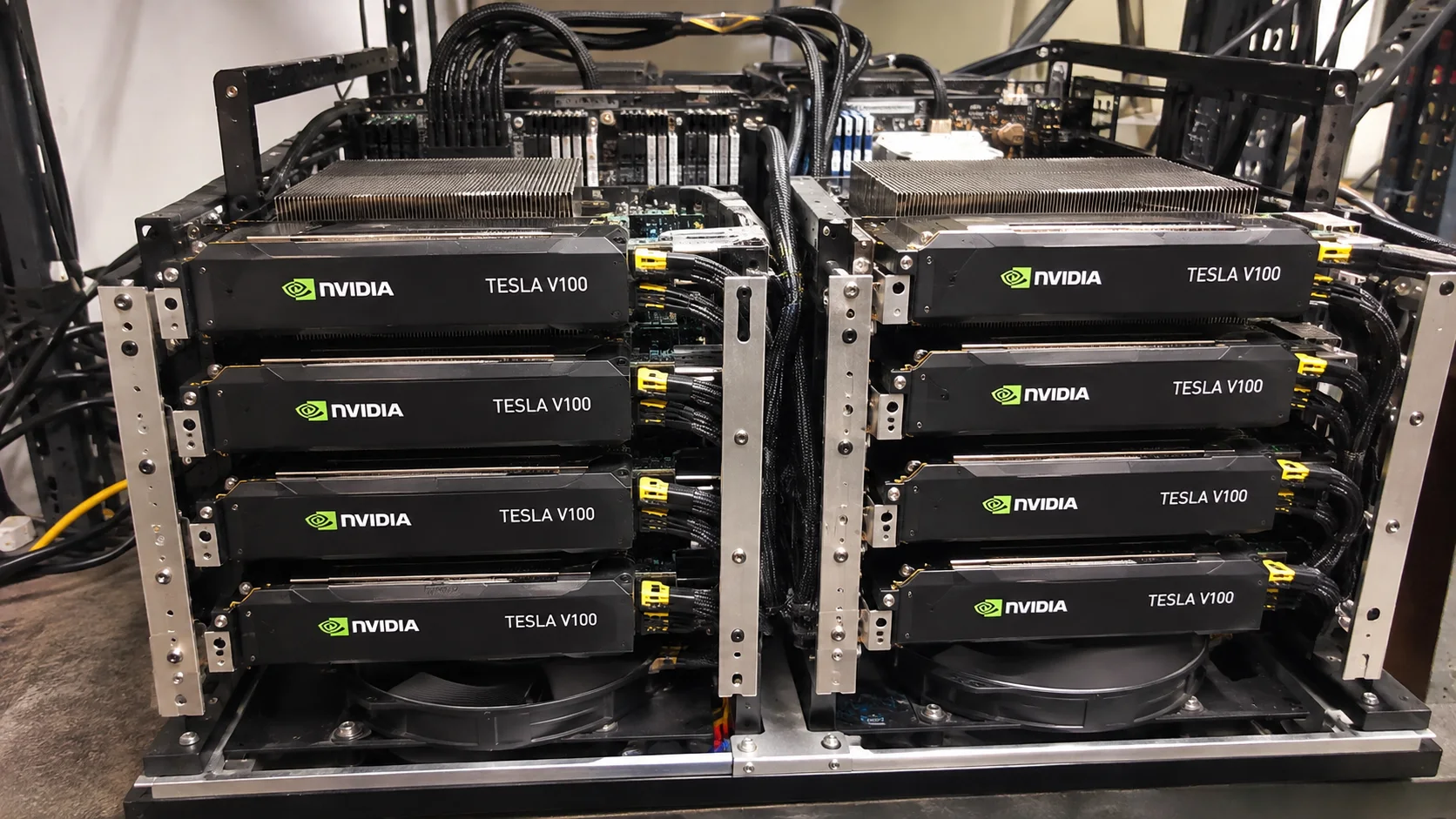
- Local, private AI keeps sensitive data in your building. It also means you own patching, power, backups and hardware failures. Our standard build is a Ryzen 9 7950X with one RTX 4090 (24 GB) and 64 GB of DDR5. It fits a defined set of sensitive workloads, not everything. We walked through a real-world version in a lawyer's private AI server built on used V100 GPUs, and what the full setup involves in what a private AI business unit actually does.
Our take: don't diversify everything. Diversify the two or three dependencies that would stop daily operations or expose confidential data. For most firms that is the internal key-holder, the model behind document-heavy workflows, and wherever sensitive files get processed.
One more control: we build on a "propose, never act" rule. AI drafts, routes and recommends; a person approves anything risky. That also limits the damage when a vendor changes a model's behavior, because a human sees the output first.
A short checklist for this quarter
- Name your single points of failure. Fill in the table above. One page.
- Add a second admin to every AI account, and move all keys into a shared vault.
- Write the runbook: what each automation does, what data it touches, which model it calls, and how to turn it off.
- Build a test set of 20 to 50 real tasks so you can check a replacement model in an afternoon, not a month.
- Run one fallback for real. Point one workflow at a second provider or a local model for a week.
- Check your contracts for data export, model retirement notice and exit terms.
- Audit hardware sourcing. Authorized resellers, documented end use, invoices on file.
- Ask your cloud and GPU providers in writing how the Nov. 16 BIS rule affects them.
FAQ
What is key-person risk in AI?
It is the risk that one person's absence, departure or compromise stops your AI systems or exposes your data. The fix is documentation, shared credentials in a vault, and a second trained admin.
Does the new BIS remote-access rule affect U.S. companies that rent cloud GPUs?
The new license requirement targets compute provided to companies headquartered in China, Macau or other Country Group D:5 destinations, and adds licensing for chips going to five named countries, with an exception for U.S.-headquartered buyers that meet reporting rules.[8] A U.S. firm renting GPUs is not the target, but its providers may face new due diligence and licensing. Ask yours.
Should we stop buying Nvidia hardware?
Nothing confirmed so far points that way. Nvidia's board says it expects customer commitments and the product roadmap to continue without interruption.[1] The better move is to keep your software portable and buy through authorized channels, so no single vendor's bad week becomes yours.
Is local AI safer than a cloud API?
It can be, for keeping sensitive data in your building, if the system is patched, backed up and access-controlled. A neglected server is its own risk. Treat local AI as one option for specific sensitive workloads.
Key specifications
Includes reported figures| Item | Value | Status | Source |
|---|---|---|---|
| Interim CEO | Colette Kress (also remains CFO) | Verified | [1] |
| Remote-access license threshold | More than 12,000,000 aggregate TPP provided to companies headquartered in Country Group D:5 or MacauPre-publication rule text; confirm against the Federal Register version. | Verified | [8] |
| Grace period for existing data centers | 90 days from the rule's effective date to obtain a license | Verified | [8] |
| New country license requirement | Indonesia, Malaysia, Singapore, Thailand, Brazil | Verified | [8] |
| Remote Access Security Act House vote | 369-22 on Jan. 12, 2026Single secondary source; congress.gov returned 403. | Reported | [9] |
Reported figures come from the listed sources and have not been independently verified by Tomorrow’s Tech AI.
Sources
- NVIDIA Announces CEO TransitionHuang resignation; Kress interim CEO and CFO; Harvey C. Jones first-ever board chair; board quote on continuity; Q3 FY2027 results Nov. 17.
- Nvidia CEO Jensen Huang resigns after his affair raises national security concernsNo succession plan; Mast subpoena remark; Nvidia 'no reason to believe' statement; Megaspeed and Singapore context.
- Trump backs campaign to reinstate Huang as CEO of NvidiaTrump remarks Nov. 16; person familiar says board not currently considering a return; Bessent called for an outside CEO.
- Explainer: Could Huang, Nvidia and company's board be held liable over affair scandal?Status of allegations (Reuters unable to verify); China calls them groundless; no criminal accusation against Huang; class action Nov. 9, derivative suit Nov. 11; Trump FBI remarks.
- Letter to Commerce Secretary Howard Lutnick on Nvidia chip export approvalsOpens an investigation and requests record preservation; describes the H200 approval and 25% Section 232 tariff as an unconstitutional export tax (their characterization).
- Department of Commerce Revises License Review Policy for Semiconductors Exported to ChinaCase-by-case review for H200, MI325X and similar chips; three applicant conditions.
- BIS Issues Rule Addressing Remote Access to American Super Intelligence TechnologyAnnounces the interim final rule; aims to stop circumvention through third-country data centers.
- Addressing Remote Access to Advanced Semiconductors (interim final rule, RIN 0694-AK50)Pre-publication text. 12,000,000 aggregate TPP threshold for data centers serving D:5/Macau-headquartered companies; 90-day window for existing providers; new license requirement for Indonesia, Malaysia, Singapore, Thailand, Brazil; rescinds AI Diffusion Rule; effective on Federal Register publication, 60-day comments.
- U.S. House Passes Bill to Curb China's Cloud Access to AI ChipsRemote Access Security Act passed the House 369-22 on Jan. 12, 2026; Senate companion introduced.
- Remote Access or Remote Possibility? RASA and the Future of Cloud Export ControlsEAR generally does not control remote access absent an export; what RASA would add.
- The U.S. banned Nvidia's best chips from going to China. Now it's trying to close a crucial loopholeReported remote use of Nvidia compute in Thailand, Malaysia and Japan by Chinese AI firms; RASA not yet passed by Senate.
- Three Charged with Conspiring to Unlawfully Divert Cutting-Edge U.S. Artificial Intelligence Technology to ChinaAllegations: about $2.5B in servers bought via a Southeast Asian company; staged dummy servers.
- California Man Arrested for Smuggling More Than $300 Million in Export-Controlled Computer Servers to ChinaAllegations: GPU servers re-exported via Malaysia and Singapore, 2023 to 2024; presumption of innocence.
- DeprecationsJun. 11, 2026 notice: GPT-5 family and o3 shut down Dec. 11, 2026; GA models get at least 6 months notice.
● Build with us
Find your AI single points of failure
We'll map your chip, cloud, model and people dependencies and build a fallback for the ones that matter. 30 minutes, no pitch, real conversation.