Beyond the Cult of Personality: How Resilient Organizations Outlast Their Founders
Nvidia's CEO exit is a lesson in key-person risk. Here's how mid-sized operators turn tribal knowledge into systems that keep running when someone leaves.

In this article
Last Thursday, Nvidia's board announced that Jensen Huang had resigned as president, CEO and board member, effective immediately.[1] He co-founded the company in 1993.[3] CFO Colette Kress is now interim CEO while the board searches for a permanent one, and Harvey C. Jones, a former CEO and executive chairman of Synopsys, became the board's first-ever chair.[1] The company reports third-quarter results tomorrow, Tuesday, November 17, as previously scheduled.[1] We won't guess at the numbers, and nothing here is investment advice.
The events that led up to the resignation are still being sorted out, and much of what has been reported remains allegation, not finding. We covered the board investigation and what it means for AI hardware buyers in our November 9 piece. This article is about something narrower and more useful to an operator: what happens to an organization that was built to run through one person, and how to build yours so it doesn't.
That isn't a judgment of Huang. By any measure he built one of the most important companies in technology. The point is the pattern. Most mid-sized companies have their own version of it: the owner who approves everything, the one dispatcher who knows which crew can actually make Tuesday, the estimator whose numbers nobody else can reproduce. When that person is gone for a week, things slow down. When they leave for good, things break.
How Nvidia was built to run
Huang has been unusually open about how he manages, and it's worth looking at plainly.
He has about 60 direct reports, far more than most CEOs.[3][2] He has said in public, including in remarks at Stanford, that he doesn't hold one-on-one meetings with them, and that he prefers to give feedback in front of the group so everyone learns from it.[4][3] Bloomberg reported on November 9 that his direct reports send him "top five things" emails that he reads and answers at all hours, and that "every major decision flows through him."[2]
There's real logic in that design. A flat structure with one sharp mind at the center moves fast and keeps everyone aligned on strategy. Fortune described Huang as seeing it as critical to staying at the cutting edge.[3]
The trade-off is that the center becomes the system. Bloomberg's summary of its November 9 story was blunt: the board was facing the possibility of a future without its singular leader.[2] Three days later, that possibility arrived.
What a prepared handoff looks like
Look at what Nvidia's board actually did, because it's a decent template at any size.
- A named interim leader on day one. Kress has been CFO since September 2013 and, the board said, has "a deep understanding of our business, customers, operations and financial position."[1]
- Separation of roles. The board created a chair position that didn't exist before, so oversight no longer sits with the person running the company.[1]
- A stated continuity commitment. Jones said the board expects "the company's operations, customer commitments and product roadmap to continue without interruption."[1]
- Scheduled obligations kept. The earnings date didn't move.[1]
Whether operations really continue without interruption is something we'll all learn over the coming quarters. That statement is the company's expectation, not a result. And the story is still moving: Fortune reported on November 15, citing the Financial Times and unnamed sources, that Huang has discussed with confidants the possibility of returning.[5] We're not going to speculate on that.
But notice what made the handoff possible at all: a deep bench of experienced leaders, a CFO with 13 years inside the numbers, and a board with the authority to act. Most companies with 40 or 400 employees have none of those. When their key person leaves, there's no press release. There's just a Monday morning where nobody knows how to price the job.
Most companies aren't ready, and the research says so
This isn't only a small-business problem. In a 2010 survey of more than 140 CEOs and directors at North American public and private companies, Stanford's David Larcker and Heidrick & Struggles' Stephen Miles found that more than half of companies could not immediately name a successor to their CEO, and 39% said they had zero viable internal candidates.[6] Boards in that survey spent about two hours a year on CEO succession.[6] Only half had a written document describing the skills the next CEO would need.[6]
That data is old, so treat it as a baseline, not a current reading. A 2014 follow-up from Stanford and the Institute of Executive Development found the gap hadn't closed: only 46% of respondents had a formal process for developing successors for key executive roles, and only 25% agreed they had an adequate pool of ready candidates for the CEO job.[7] The same report noted that companies mostly treated succession as downside protection rather than as part of how they develop people.[7]
Our take: if large public companies with boards, HR departments and governance consultants struggle with this, a 60-person contractor with no HR department is almost certainly more exposed. The difference is that the contractor's "key people" aren't only the CEO. They're the dispatcher, the estimator and the office manager who knows where the passwords are.
Your company's version of the pattern
Before founding Tomorrow's Tech AI, I was a project and program manager running construction and telecom infrastructure programs: field crews, contractors, schedules, compliance. Our take from that kind of work: the failure to worry about usually isn't bad people. It's good people carrying the system in their heads, because routing work through them is faster than writing it down, right up until they're out sick, on vacation or gone.
The fix isn't to make those people less important. It's to move what they know out of their heads and into systems that keep working when they step away. Here is how that maps, role by role.
| Key-person dependency | What breaks when they leave | The system that replaces the dependency |
|---|---|---|
| Owner approves every quote, discount and purchase over a few hundred dollars | Work stalls in an inbox; customers wait; staff stop making decisions | Written approval thresholds by role, an approval workflow with a named backup approver, and an audit trail |
| Lead dispatcher knows which crews are qualified, available and certified | Wrong crew on the wrong job; missed starts; compliance gaps | A crew master record (certifications, availability, capacity) that blocks bad assignments at schedule time |
| Senior estimator prices from memory and old spreadsheets | Bids go out late, inconsistent or underpriced | A cost database, a standard estimate template, and a review step for bids over a set value |
| Project manager holds the real schedule and vendor commitments | Dates slip silently; nobody knows what was promised | A shared schedule as the system of record, with explicit task states and an owner on every line |
| Office manager handles vendor payments, renewals and logins | Missed payments, lapsed licenses, locked accounts | A renewals calendar, a company-owned password manager, and a written month-end runbook |
| "The person who set up the software" | Integrations fail and nobody can fix or even find them | An inventory of every tool, integration and admin account, plus monitoring that alerts more than one person |
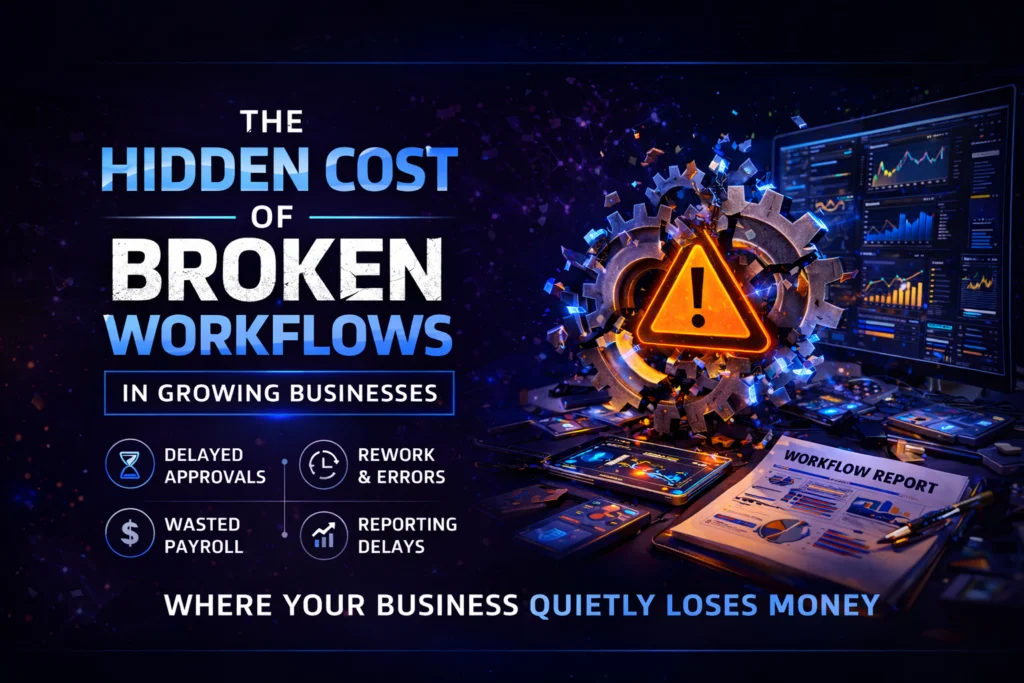
None of this is exotic. It's the same discipline a good PMO applies to a program: write it down, give every item an owner and a state, and make the status visible to more than one person. We've written about the cost of skipping it in the hidden cost of broken workflows.
Five layers that make a company outlast any one person
1. A system of record. One place where the truth lives for each kind of work: jobs, crews, bids, customers, vendors. Not "the spreadsheet on Mike's laptop." If you can't point to where something lives, it lives in someone's head.
2. Written SOPs, short and current. A one-page procedure that a competent new hire can follow beats a 40-page manual nobody opens. Write them for the tasks that only one person can do today. Review them when the process changes, not once a year.
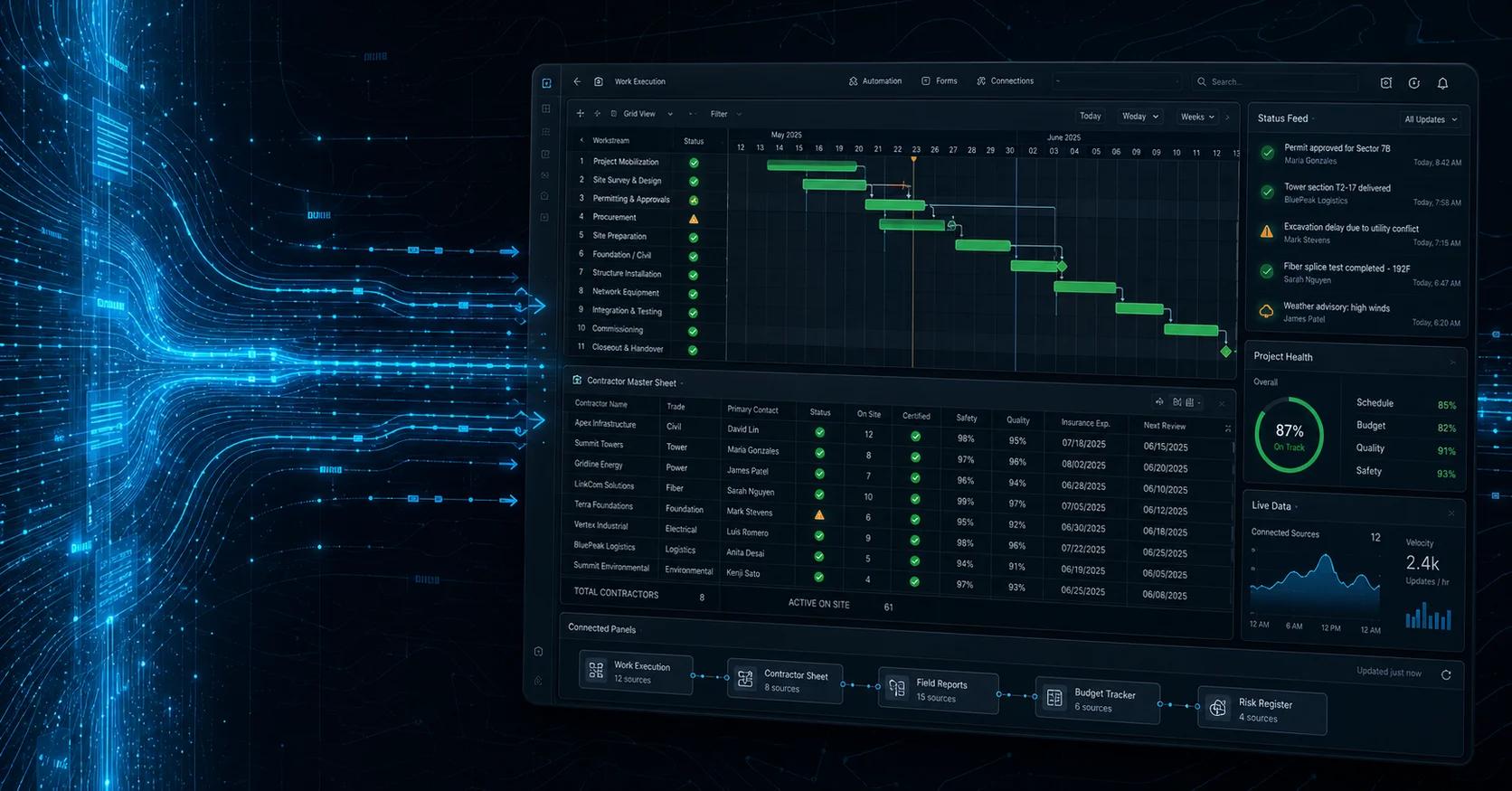
3. Workflows with explicit states and owners. Every request, bid, job and approval should have a status (submitted, in review, approved, scheduled, done) and a named owner. When the owner is out, the work is visible and can be reassigned instead of disappearing. This is the core of what a command center does: it shows the state of the business without anyone having to ask.
4. AI that drafts and routes, while people approve. This is where AI earns its keep in continuity. An AI agent can read the documented procedures and the system of record, draft the estimate, propose the crew assignment, flag the expiring certification, and route the item to the right approver. What it shouldn't do is act on its own on anything risky: sending a bid, committing a crew, paying a vendor. Our rule is "propose, never act." The AI does the legwork and makes the knowledge usable; a person makes the call. That keeps a human accountable and keeps you from swapping one single point of failure (a person) for another (an unsupervised agent).
5. Monitoring and handoff runbooks. Automations fail quietly. Someone besides the builder should get the alert, and there should be a written runbook that says what each automation does, what "broken" looks like, and who to call. The same runbook format works for people: what this role does weekly, where the files are, which vendors expect what, and which decisions it can make alone.
What to do this quarter
A practical checklist. You don't need software to start; you need an afternoon and honesty.
- Name your Jensens. List every person whose absence for two weeks would stall revenue, scheduling, billing or compliance.
- Ask each one for their "top five." Borrow the idea: ask each key person for the five things only they know how to do. That's your documentation backlog.
- Write one SOP per person per month. Start with the task that would hurt most if it stopped.
- Assign a backup for every approval. Then test it: have the backup approve for a week while the primary is still around.
- Move company credentials into a company-owned password manager. Personal accounts and sticky notes are a key-person risk all by themselves.
- Inventory your automations. List each one, what it touches, who built it, and who gets alerted when it fails.
- Pilot one AI-assisted workflow with an approval step. Pick something documented and repetitive, like drafting quotes from a standard template, and keep a human approving every output.
Frequently asked questions
What is key-person risk?
It's the exposure a business carries when a critical function depends on one individual's knowledge, relationships or authority. If that person leaves, gets sick or is simply unavailable, the function slows or stops. It applies to owners and CEOs, but in mid-sized operations it's just as often a dispatcher, estimator or office manager.
How do you reduce key-person dependency in a small business?
Document what the person knows (short SOPs), put the work into a shared system of record with clear statuses and owners, name a backup for every approval, and test the backups while the key person is still there. Then add monitoring so failures reach more than one person.
Can AI replace an employee's knowledge when they leave?
Not on its own. AI can only work with what's been written down or recorded in your systems. Once that knowledge is documented, AI is very good at drafting, summarizing and routing work from it. It should propose actions for a person to approve, not take risky actions by itself.
What should a handoff runbook include?
What the role or automation does, how often, where the files and accounts live, which outside parties depend on it, what normal and broken look like, who has authority to make which decisions, and who to call when something goes wrong.
Where sources disagree
Colette Kress's career before Nvidia
- [1] Nearly 25 years in finance roles at technology companies including Cisco and Microsoft.
- [4] Nearly three decades in finance roles at Texas Instruments, Cisco and Microsoft before joining Nvidia in September 2013.
Our read: The article avoids the year count and cites only Nvidia's release for her Nvidia tenure (CFO since September 2013).
Sources
- NVIDIA Announces CEO Transition
- Nvidia CEO Jensen Huang's Affair With Alleged Spy Raises Succession ConcernsUsed only for the description of Huang's management structure (about 60 direct reports, 'top five things' emails, decisions flowing through him). Paywalled beyond the opening.
- 60 direct reports, but no 1-on-1 meetings: How an unconventional leadership style helped Jensen Huang of Nvidia become one of the most powerful people in business
- Jensen Huang had a strict no one-on-one meetings rule for his 60 direct reports, and Nvidia's interim CEO has a similar mantraUpdated version of a June 12, 2024 article; reports Huang's remarks at Stanford University.
- Treasury Secretary Scott Bessent says if Nvidia was a bank, 'a lot of the executives would be removed'Cited only for Fortune's report, attributed to the Financial Times and unnamed sources, that Huang has discussed a possible return. Not independently verified.
- 2010 CEO Succession Planning SurveySurvey of 140+ CEOs and directors at North American public and private companies, spring 2010.
- 2014 Report on Senior Executive Succession Planning and Talent Development
● Build with us
Get your tribal knowledge into a system
We turn the work only one person knows into documented workflows with owners, so the business keeps running. 30 minutes, no pitch, real conversation.