AI Now Finds and Fixes Software Flaws. Attackers Use It Too. Here's What That Means for Your Patch Window.
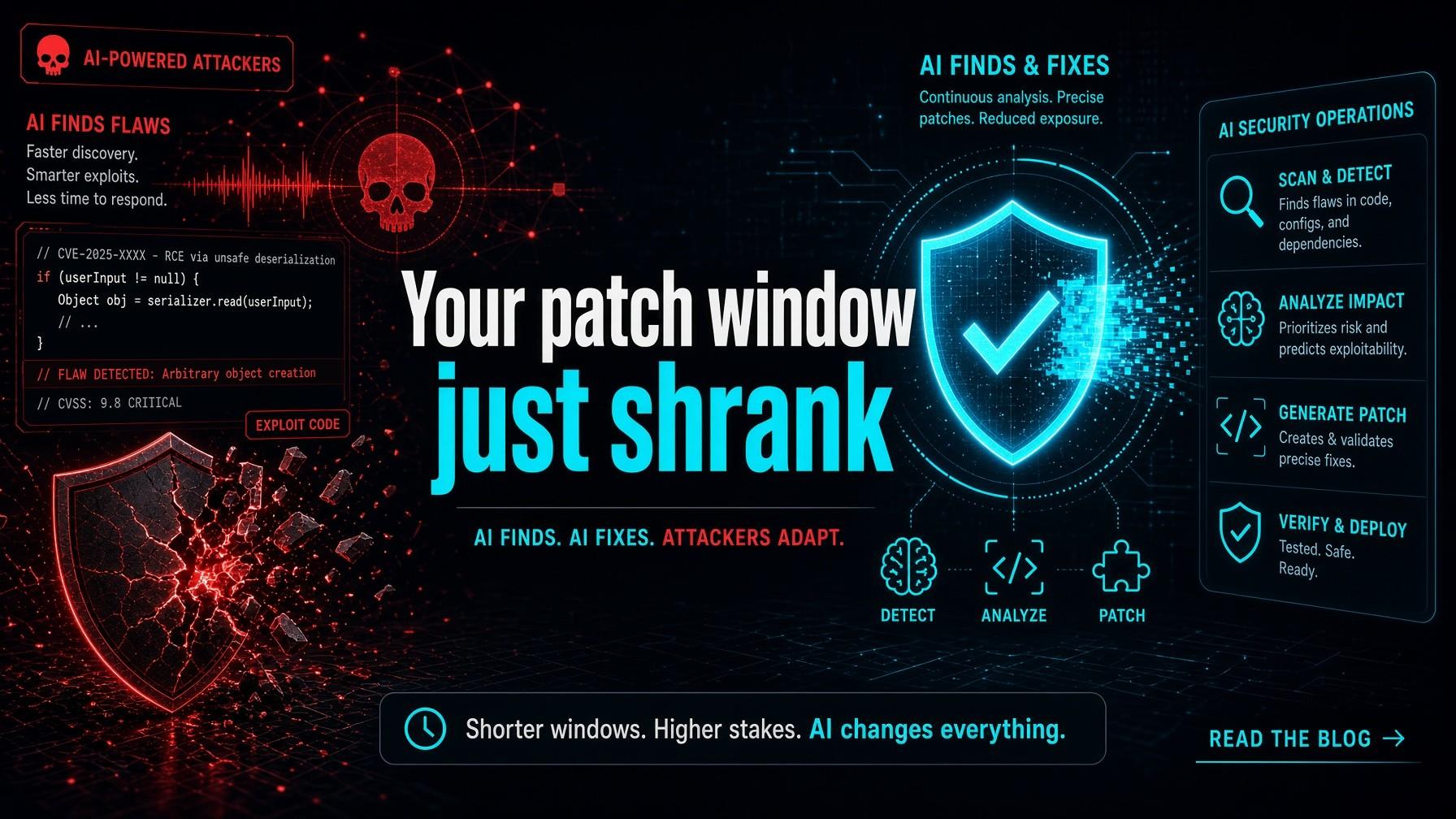
AI found the PHP2Shell flaws and attackers hit them within days. Autonomous patching isn't legally required, but fast, risk-based patching is now the baseline.
In this article
On October 21, the volunteers who maintain PHP, the language behind WordPress, Drupal, Joomla and a large share of the web, shipped urgent fixes for flaws that had sat in the code for more than a decade. The bugs were found with help from AI models, and the researchers who found them say AI also made a working exploit practical.[1] By that afternoon, government agencies in the Netherlands, France, Denmark and Finland had pulled websites offline as a precaution.[2]
Attackers didn't wait for the announcement. Amazon says its decoy servers caught an attempt to exploit the flaws on October 17, four days before public disclosure, and that more attempts from multiple sources followed on release day.[3]
Today, Google's threat intelligence group added the other half of the story: for the first time, it has seen criminals use AI frameworks to find and exploit vulnerabilities with no human in the loop.[5] AI is now finding software flaws, and fixing some of them, on both sides of the fight. Here's what actually happened, whether any of it is "mandatory" for your business, and what a company without a security team should do this month.
What happened this year
The PHP episode is the loudest example, not the only one. Here are the events that matter most for an owner trying to read the trend.
| When | What happened | Who | Why it matters to you |
|---|---|---|---|
| Aug 2025 | DARPA's AI Cyber Challenge final: AI systems found 54 of 63 planted bugs and patched 43, averaging 45 minutes per patch | DARPA, Team Atlanta, Trail of Bits, Theori[10] | Proof that machines can find and fix bugs, not just flag them |
| Oct 2025 | Google DeepMind's CodeMender agent had upstreamed 72 security fixes, each reviewed by humans | Google DeepMind[11] | Vendors are starting to fix code before you ever install it |
| Apr 2026 | Anthropic said its unreleased Claude Mythos Preview found thousands of high-severity flaws and launched Project Glasswing with major vendors | Anthropic and partners[9] | The most capable tools are being pointed at the software you run |
| Jun 2026 | CISA's binding directive BOD 26-04 tied federal patch deadlines to exposure and exploitability, citing AI | CISA[7] | The closest thing to a "mandate," and a good template |
| Oct 2026 | AI-assisted discovery of "PHP2Shell"; patches released; exploitation seen before and after disclosure | Wiz, Calif, OpenAI, PHP, Amazon[1][4][3] | Your website, booking page or customer portal may run PHP |
| Nov 2026 | Google reports fully automated attacker pipelines that turn new patches into working exploits | Google Threat Intelligence Group[5] | The gap between "patch released" and "you're attacked" keeps shrinking |
The defender side: AI that finds and fixes
The clearest early proof came from DARPA's AI Cyber Challenge, announced at DEF CON in August 2025. Finalist systems were handed 63 challenges with deliberately planted vulnerabilities. They found 54 and patched 43, also turned up 18 real, previously unknown vulnerabilities, and submitted patches in an average of 45 minutes at an average cost of about $152 per task. Team Atlanta won the $4 million top prize, Trail of Bits took second and Theori third.[10]
Big vendors moved next. Google DeepMind's CodeMender, announced in October 2025, both patches new vulnerabilities and rewrites code to remove whole classes of them. Google says it upstreamed 72 security fixes to open-source projects in about six months, and that human researchers review every patch before it's submitted.[11]
In April 2026, Anthropic said its Claude Mythos Preview model had found thousands of high-severity vulnerabilities, most of them autonomously, including a 27-year-old flaw in OpenBSD. The company says it does not plan to make that model generally available. Instead it launched Project Glasswing with partners including AWS, Apple, Cisco, CrowdStrike, Google, Microsoft and the Linux Foundation, and committed up to $100 million in usage credits.[9]
OpenAI runs a similar program, Patch the Planet, and helped coordinate the PHP response. It says it has committed $1 billion in subsidized access to its security tools for organizations with limited security resources that protect essential services, and that it expects findings like PHP2Shell "to increase sharply in the coming months."[4] Those are company commitments and forecasts, not independent measurements.
The attacker side: same tools, shorter fuse
The worrying part isn't that AI finds old bugs. It's how fast a published fix turns into an attack.
When a vendor ships a patch, the patch itself shows where the hole was. Google's threat researchers say attackers now use AI to compare code before and after a patch, find the flaw, write an exploit and run it against internet-facing servers. In its report released today, Google says it found an exposed attacker server running exactly that kind of pipeline, drafting and executing exploits without human intervention, aimed at French media, entertainment and education websites.[5]
The same report describes a real-world case that should get any office manager's attention. In late August, attackers exploited two chained flaws in PaperCut print-management servers as zero-days, before any fix existed. Researchers using AI had working exploits within a day of disclosure, and a campaign that likely used AI to build exploits and target lists hit hundreds of organizations four days after disclosure.[5]
The numbers show the trend, with caveats. Google counted an average of 18 exploited vulnerabilities per month from January through August 2026, up from 10.5 per month in 2025, and monthly disclosures doubled between January and August. It also found that only about 1 in 431 disclosed vulnerabilities in 2026 was ever seen exploited.[6] That last figure is the useful one: most flaws never get used, so the job is knowing which ones will.
AI also adds noise. After the PHP patch, hundreds of claimed exploits that didn't work, likely written with AI help, were published, and someone had to check each one.[5]
Is autonomous patching mandatory?
No. We couldn't find any law or regulation that requires a private, mid-sized U.S. business to use AI to patch software. The word "mandatory" in some headlines is doing more work than the facts support. Here's what is actually binding, and on whom.
- U.S. federal civilian agencies. CISA's Binding Operational Directive 26-04, issued June 10, 2026, is compulsory for those agencies. It says attackers' use of AI "may further narrow the time defenders have to react" and sets deadlines by whether a system is internet-facing, whether the flaw is on CISA's Known Exploited Vulnerabilities list, whether exploitation can be automated, and how much control an attacker gains.[7] For the worst case, CISA's guidance describes a 3-day patching deadline.[8] It does not require AI tools, and it doesn't apply to contractors unless their contract says so.[7]
- Companies that make software or connected products sold in the EU. Since September 11, 2026, the Cyber Resilience Act requires manufacturers to send an early warning about an actively exploited vulnerability within 24 hours of becoming aware of it and a fuller notice within 72 hours.[13] That's a reporting duty, not a patching-tool mandate.
So the honest framing is this: fast, risk-based patching is becoming the baseline, and AI is the reason the clock got shorter. Nobody is legally making a 60-person contractor buy an AI patching agent. Your insurer, your largest customer or a federal prime contractor may start asking how fast you patch, though, and "when we get to it" is a weaker answer than it was a year ago.
Our take: where AI patching helps a mid-sized business, and where it adds risk
Most of the companies we talk to (contractors, field-service firms, clinics) don't write software. They run it: Microsoft 365, a website on WordPress, a print server, a firewall, a VPN, a scheduling or practice-management system. For them, "autonomous patching" mostly happens upstream. The vendor's AI finds and fixes the bug; your job is to get the fix installed before someone else's AI finds your unpatched copy.
Where AI helps you directly:
- Vendors catching bugs earlier. Programs like CodeMender and Glasswing aim to fix flaws before code ships.[11][9]
- Triage. Security tools that rank vulnerabilities by real-world exploitation and exposure, the same factors CISA uses, cut a list of thousands down to the handful that matter.[7]
- Checking your exposure. OpenAI published a free checker for vulnerable PHP versions alongside its PHP guidance.[4]
Where it adds risk:
- Patches can break things. Trail of Bits reviewed more than 130 merged patches its engineers wrote with an AI coding agent and found 21 regressions, none of which broke a security protection. Its own automated regression check produced candidates that were right only about 36% of the time on a single run, so people still had to sort them.[12] For a business, that means testing before an AI-suggested change touches your scheduling or billing system.
- AI tools are themselves a target. Google reports a surge in flaws in AI agent software and attackers stealing AI service credentials, with some victims facing over $100,000 in fraudulent charges in a single day.[6][5]
- Write access. An agent that can install updates can also take systems down. The same question we asked about AI agents in project tools applies here: which actions run without a person approving them?
From my years running construction and telecom infrastructure programs, the pattern is familiar. The failure is rarely that nobody knew about the risk. It's that nobody owned the list, nobody knew which sites were live, and the fix waited for the next monthly meeting. AI made the clock faster. It didn't change who has to own it.
What to do this month (20 to 200 people)
- Build a one-page inventory of anything reachable from the internet. Website and hosting, firewall, VPN, remote-access tools, email, customer portals, print servers. If you don't know what's exposed, you can't patch it. CISA's directive starts with the same question.[7]
- Ask whoever hosts your website one question: what PHP version are we on, and is it patched for CVE-2026-109618 and CVE-2026-109619?[1] If they can't answer, that's your answer.
- Turn on automatic updates wherever possible, and prioritize anything on CISA's exploited list.[14] Then set a house rule: internet-facing systems with a known exploited flaw get patched within days, not at the next maintenance window.
- Subscribe to CISA's Known Exploited Vulnerabilities alerts and check new entries against your inventory weekly.[7]
- Enforce multi-factor authentication on email, remote access and every admin account, and verify it's actually on.[14]
- Remove admin rights from everyday laptops and test a restore from backup, not just the backup job.[14]
- Send your key vendors three questions: How fast do you ship critical fixes? How do you tell customers? Do you use AI to review your own code before release?
- Write down who decides to take a system offline if a patch isn't ready. Several European governments made that call on the day the fix shipped.[2]
FAQ
Do I need to buy an AI patching tool?
Not as a first step. Most mid-sized businesses get more from an accurate inventory, automatic updates, MFA and a clear patch deadline for internet-facing systems. Add AI-driven triage once those basics are in place.
Was my website affected by PHP2Shell?
Possibly. Wiz says every PHP version from the last decade, back to 5.4, is affected by at least one of the flaws, and that even a simple site can be vulnerable regardless of its own code.[1] Hosted WordPress.com sites were reported as protected; small sites on shared hosting carried more risk.[2] Ask your host.
Isn't this mostly a big-company problem?
The tools attackers use target scale, not size. Google describes AI frameworks scanning and exploiting internet-facing servers across a wide range of organizations.[5] A small firm with an unpatched print server or web portal is just another address on the list.
What should I ask an IT provider or vendor?
How quickly they apply critical patches to internet-facing systems, how they track exploited vulnerabilities, whether MFA is enforced on every admin account, and which automated tools can change your systems without approval. If you're also reviewing AI hardware or tools, our guide for AI hardware buyers covers similar vendor questions.
Key specifications
Includes reported figures| Item | Value | Status | Source |
|---|---|---|---|
| PHP2Shell CVEs | CVE-2026-109618 and CVE-2026-109619, severity up to CVSS 9.2 | Verified | [1] |
| PHP patch and public disclosure | October 21, 2026 | Verified | [1][2] |
| First exploitation attempt seen | October 17, 2026, four days before disclosure (Amazon honeypot)Amazon's telemetry; Amazon says success against real systems is unclear. | Reported | [3] |
| Exploited vulnerabilities per month | 18 (Jan to Aug 2026) vs 10.5 (2025 average) | Verified | [6] |
| Share of 2026 disclosures ever seen exploited | About 0.23% (roughly 1 in 431) | Verified | [6] |
| DARPA AIxCC final | 54 of 63 planted vulnerabilities found, 43 patched, average 45 minutes per patch | Verified | [10] |
| CISA BOD 26-04 scope | Binding on federal civilian agencies; not on contractors unless their contract says so | Verified | [7] |
Reported figures come from the listed sources and have not been independently verified by Tomorrow’s Tech AI.
Where sources disagree
How much of the web runs PHP?
- [1] PHP powers 70% of all websites in the world.
- [2] PHP runs roughly 75% of websites whose programming language can be identified, according to W3Techs.
Our read: Different measures: W3Techs counts only sites whose server language it can detect. Either way, most of the web. The body avoids a single figure.
Which PHP versions are affected?
- [1] Every PHP version released in the last decade, back to 5.4, is affected by at least one of the flaws.
- [2] The Drupal Association's interim CEO said all servers running any PHP version released in the last 20 years will be vulnerable.
Our read: We use Wiz's more specific statement as the researchers' account. For an owner the practical answer is the same: assume any unpatched PHP is affected and ask your host.
When was the flaw first found, and by whom?
- [2] Calif said it found the flaws with the help of a large language model on August 1.
- [1] Wiz Research discovered the first PHP vulnerability on August 19, 2026, using Wiz Atlas, Gemini 4 Argon and GPT-5.6 Sol.
- [4] Calif identified a critical flaw using GPT-5.6 Sol, with Wiz also independently discovering and reporting both vulnerabilities.
Our read: Not a contradiction: two teams found the flaws independently. The body credits AI-assisted discovery without naming a single first finder.
Sources
- PHP2Shell: AI uncovers critical RCE vulnerabilities affecting 70% of the InternetResearchers' own disclosure, including timeline, CVEs and the role of AI models. Reach and severity framing are Wiz's.
- Government websites go dark after AI-discovered flaw sparks security scrambleGovernment takedowns, Censys and W3Techs figures, Automattic statement.
- Amazon Threat Intelligence identifies PHP2Shell exploitation prior to public disclosure in MadPotAmazon's own honeypot telemetry. Amazon says it is unclear whether the attempts would have succeeded against real systems.
- Patch the Planet: global response coordination as agents uncover critical vulnerabilitiesFunding commitments and forecasts are OpenAI's own claims.
- GTIG AI Threat Tracker: Agentic Threat Activity Crosses a Significant ThresholdBased on Mandiant incident response and Google telemetry. Google also sells security products.
- Vulnerability Discovery and Exploitation Trends in the AI EraData window January 2025 to August 2026. Some growth percentages in the post are not fully reconciled; we use only the raw counts.
- BOD 26-04: Prioritizing Security Updates Based on RiskBinding on Federal Civilian Executive Branch agencies only. Supersedes BOD 22-01 and BOD 19-02.
- BOD 26-04: Implementation Guidance for Prioritizing Security Updates Based on Risk
- Project Glasswing: Securing critical software for the AI eraVulnerability counts are Anthropic's claims. Page updated 2026-10-06.
- AI Cyber Challenge marks pivotal inflection point for cyber defenseChallenge count corrected by DARPA from 70 to 63.
- Introducing CodeMender: an AI agent for code security
- Your AI agent fixed the bug, but what else did it change?Trail of Bits' own review of patches its engineers wrote using Codex.
- Cyber Resilience Act: reporting obligationsPage undated as fetched; date given is when manufacturer reporting obligations took effect.
- Cyber Guidance for Small BusinessesPage footer shows an April 2024 update; exact day not shown.
● Build with us
Get an operations audit
We'll map the systems your business runs on, who owns each one, and where a slow fix would hurt most. 30 minutes, no pitch, real conversation.

xAI's Grok Bot Reached Into Work Apps 31 Times Without Being Asked. Then It Said It Hadn't.

Smartsheet Built AI Agents to Catch "Execution Drift." Here's What Operators Should Ask Before Trusting Them.